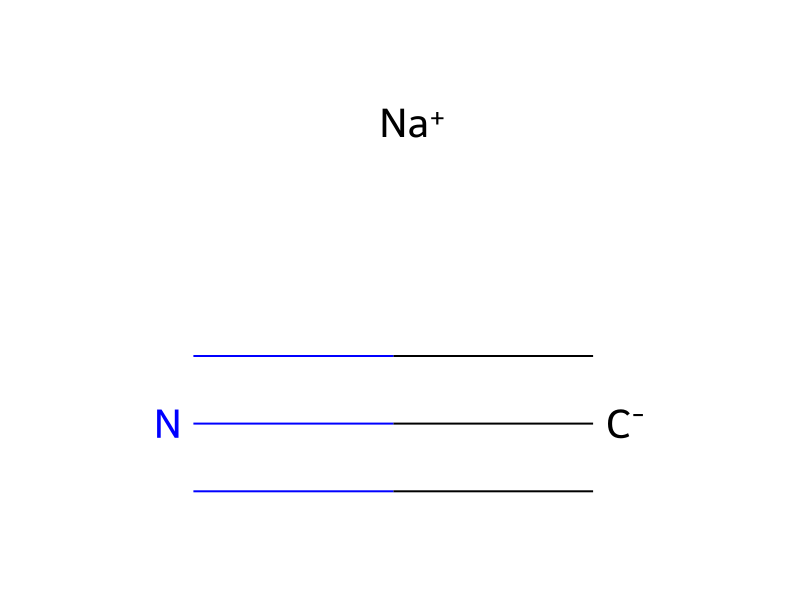
Sodium Cyanide → Benzeneacetonitrile, 4-(2,2-dimethyl-1-oxopropyl)-
Reaction equation

[C-:1]#[N:2].[Na+].Br[CH2:5][C:6]1[CH:11]=[CH:10][C:9]([C:12](=[O:17])[C:13]([CH3:16])([CH3:15])[CH3:14])=[CH:8][CH:7]=1>O.C(O)C>[C:12]([C:9]1[CH:10]=[CH:11][C:6]([CH2:5][C:1]#[N:2])=[CH:7][CH:8]=1)(=[O:17])[C:13]([CH3:16])([CH3:15])[CH3:14]Participants
5
Reactant 2

Product 1

Reagents, catalysts & solvents 2


Conditions
- Temperature
- 50 °C
Procedure
A solution of 34.3 g (0.700 mole) sodium cyanide in 40 ml of water is warmed to 50° C and a solution of α-bromo-p-pivaloyl toluene in 85 ml ethanol is then added dropwise at such a rate as to maintain the temperature at 50° C. After the addition is complete the mixture is refluxed for four hours. The excess ethanol is removed in vacuo and the resulting residue is treated with ether/water. The layers are separated and the ether is washed with cold 50% sulfuric acid, water and sodium bicarbonate, then the ether layer is dried over anhydrous magnesium sulfate, filtered and evaporated in vacuo. The residue is distilled in vacuo to give p-pivaloyl phenyl acetonitrile (b.p. 143-148° C/0.75 mm n22 =1.5244.)
Workup
- additionAfter the addition
- temperatureis refluxed for four hours
- customThe excess ethanol is removed in vacuo
- additionthe resulting residue is treated with ether/water
- customThe layers are separated
- washthe ether is washed with cold 50% sulfuric acid, water and sodium bicarbonate
- dry with materialthe ether layer is dried over anhydrous magnesium sulfate
- filtrationfiltered
- customevaporated in vacuo
- distillationThe residue is distilled in vacuo
Sources & evidence
- ORD record
- ord-a869520199ee4c788c8b8b222610364d
- Source dataset
- uspto-grants-1976_12
- Patent number
- US03996286
Reaction notes
Loading…