Chlorosulfonic acid → 4-Bromo-2,5-di(propan-2-yl)benzene-1-sulfonyl chloride
Reaction equation

[Br:1][C:2]1[CH:7]=[C:6]([CH:8]([CH3:10])[CH3:9])[CH:5]=[CH:4][C:3]=1[CH:11]([CH3:13])[CH3:12].[Cl:14][S:15](O)(=[O:17])=[O:16]>C(Cl)(Cl)(Cl)Cl>[Br:1][C:2]1[C:3]([CH:11]([CH3:13])[CH3:12])=[CH:4][C:5]([S:15]([Cl:14])(=[O:17])=[O:16])=[C:6]([CH:8]([CH3:9])[CH3:10])[CH:7]=1Participants
4
Reactant 2
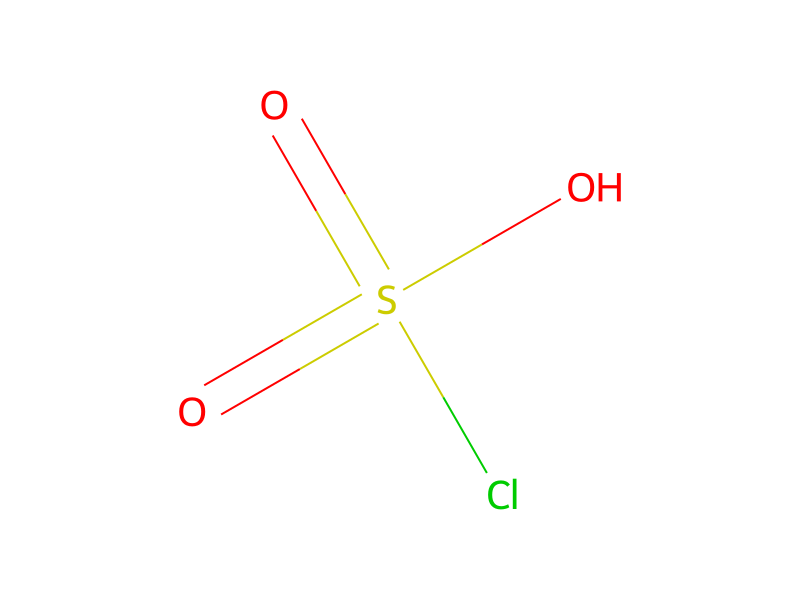

Product 1

Reagents, catalysts & solvents 1

Procedure
To a one-liter flask containing 80 parts of 2-bromo-1,4-diisopropylbenzene in 320 parts of carbon tetrachloride, there is added over 15 min. 154 parts of chlorosulfonic acid. After stirring thirty min. longer, the reaction mixture is poured onto 1000 parts of ice. The organic layer is separated and washed with 200 parts of water and then dried over magnesium sulfate. Removal of the solvent under reduced pressure gives 105 parts of 4-bromo-2,5-diisopropylbenzenesulfonyl chloride which can be recrystallized from n-hexane, m.p. 80°-83°.
Workup
- additionis added over 15 min
- additionthe reaction mixture is poured onto 1000 parts of ice
- customThe organic layer is separated
- washwashed with 200 parts of water
- dry with materialdried over magnesium sulfate
- customRemoval of the solvent under reduced pressure
Sources & evidence
- ORD record
- ord-7e974b47a08b4f6fb4a97fdc00de500d
- Source dataset
- uspto-grants-1976_12
- Patent number
- US03997603
Reaction notes
Loading…