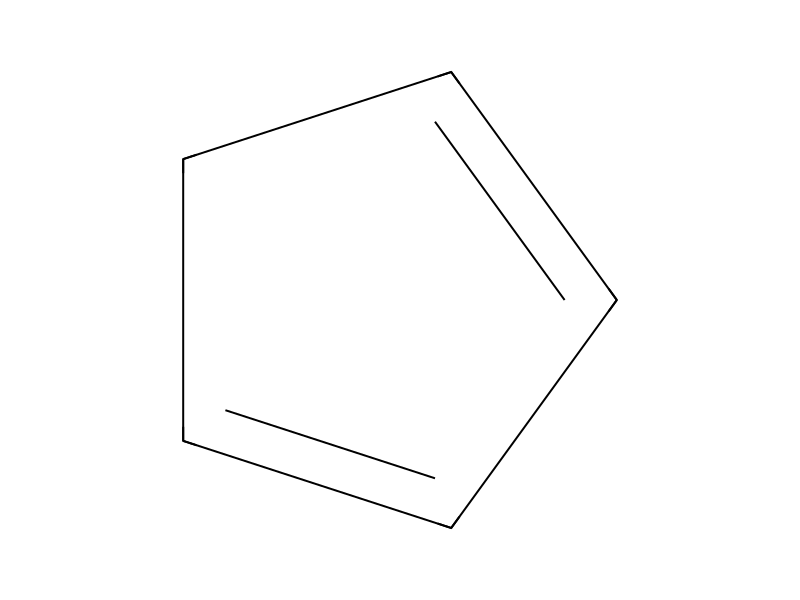
Cyclopentadiene → HCID 131722567, compound
Reaction equation

Br[CH2:2][CH:3]=[C:4]([CH3:6])[CH3:5].[CH:7]1[CH2:11][CH:10]=[CH:9][CH:8]=1.[OH-].[Na+]>CCCCCCCC[N+](CCCCCCCC)(CCCCCCCC)C.[Cl-].O>[CH3:5][C:4]([CH3:6])=[CH:3][CH2:2][C:8]1([CH2:2][CH:3]=[C:4]([CH3:6])[CH3:5])[CH:7]=[CH:11][CH:10]=[CH:9]1Participants




Procedure
A 1.0 L double-walled reactor, provided with baffles, condenser, top stirrer, thermometer and dropping funnel equipped with a nitrogen inlet was charged with ALIQUAT 336 (4.0 g, 10 mmol), 4-bromo-2-methyl-2-butene (30.0 g, 0.20 mol) and freshly cracked cyclopentadiene (6.6 g, 0.10 mol). A 50 wt. % NaOH aqueous solution (84 g) was then added via the dropping funnel to the turbulently stirred reaction mixture. The reaction mixture was cooled with water during the addition of the base. After 5.5 hours of stirring at room temperature, the stirring was stopped, the layers separated and the product was distilled at reduced pressure. After vacuum distillation, 3.4 g of di-(3-methyl-2-butenyl)-cyclopentadiene were obtained. Characterizaton of the product took place with the aid of GC, GC-MS, 13C- and 1H-NMR.
Workup
- customA 1.0 L double-walled reactor, provided with baffles, condenser, top stirrer
- customequipped with a nitrogen inlet
- customthe layers separated
- distillationthe product was distilled at reduced pressure
- distillationAfter vacuum distillation
Sources & evidence
- ORD record
- ord-642115a33575436a914a98037c739b60
- Source dataset
- uspto-grants-2001_05
- Patent number
- US06232516B1
Reaction notes
Loading…