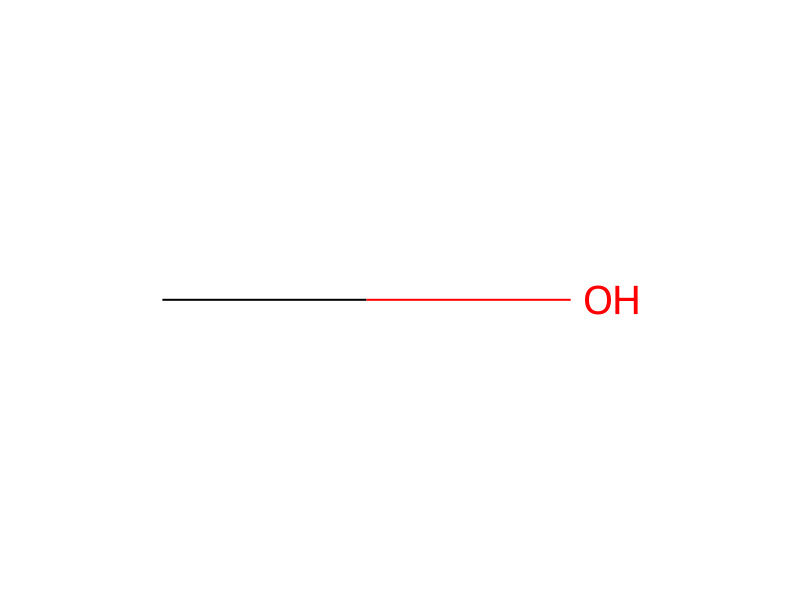
Methanol → Butyl disulfide
Reaction equation

O=O.[CH2:3]([SH:7])[CH2:4][CH2:5][CH3:6].CO.[OH-].[Na+]>O>[CH2:3]([S:7][S:7][CH2:3][CH2:4][CH2:5][CH3:6])[CH2:4][CH2:5][CH3:6]Participants
Reactant 4


Product 1

Reagents, catalysts & solvents 1
Procedure
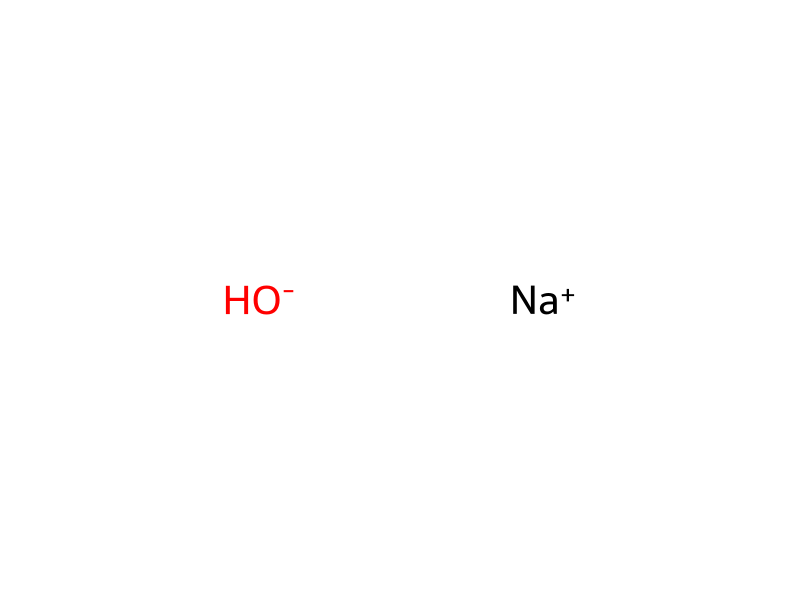
This example illustrates the invention and shows that when the reaction liquid is circulated through a restricted area (aspirator) such that a more intimate contact with oxygen is made, the rate of reaction (rate of mercaptan conversion) is greatly increased. A 10-gallon glass-lined reactor, equipped with a Scott oxygen analyzer, reflux condenser, stirrer, thermocouple and circulating inlet tube as shown in FIG. 1 was charged with 38 pounds (0.42 pound moles) of n-butyl mercaptan, 17.2 pounds (0.432 pound moles) of methyl alcohol and 0.91 pounds (0.023 pound moles) of sodium hydroxide. The reactor was sealed and pressured with nitrogen to 220 psig. The stirrer was started and the liquid externally circulated at 1.5-2 gallons per minute using a Lawrence can pump by first passage through a heat exchanger and then being passed through an Ametex water jet exhauster (aspirator) having a 1.27 cm (0.50 in.) opening on the circulated side and a 0.635 cm (0.25 in.) opening on the suction side. The liquid was then returned to the vapor phase of the reactor. Oxygen was then added such that entry was made through the aspirator (see FIG. 1). The system was pressured to about 280 psig with the additional oxygen and the amount of oxygen present in the vapor phase of the reactor monitored by a Scott analyzer and maintained at about 20 mole percent. The reaction temperature immediately began to slowly rise such that after about 1 hour the temperature in the liquid phase of the reactor was about 60° C. (140° F.). The temperature was maintained between about 49° C.-60° C. (120° F.-140° F.) throughout the run. After 1 hour analysis indicated the reaction was 65 percent complete and after 2 hours the reaction was complete as determined by GLC. The product was separated and dried as previously described to give 33.3 pounds (88.6 mole percent yield) of essentially pure di-n-butyl disulfide. A comparison of the rates of reaction carried out by the closed system (Example I) and the circulating-intimate mixing system (Example II) is shown in Table I and FIG. 2. When another run employing the method described in Example II was carried out wherein the separated oil was distilled rather than air dried at 100° C.-120° C., the yield of di-n-butyl disulfide was increased giving 35 pounds (93.1 mole percent) of product.
Workup
- customthe reaction liquid
- temperatureis greatly increased
- temperaturereflux condenser, stirrer
- customThe reactor was sealed
- temperaturemaintained at about 20 mole percent
- customafter about 1 hour
- customwas about 60° C.
- custom(140° F.)
- temperatureThe temperature was maintained between about 49° C.-60° C. (120° F.-140° F.) throughout the run
- waitafter 2 hours the reaction was complete
- customThe product was separated
- customdried
- customto give
Sources & evidence
- ORD record
- ord-fac0f0dbd6cb4f74976ce3f00f006a83
- Source dataset
- uspto-grants-1984_11
- Patent number
- US04483826
Reaction notes
Loading…