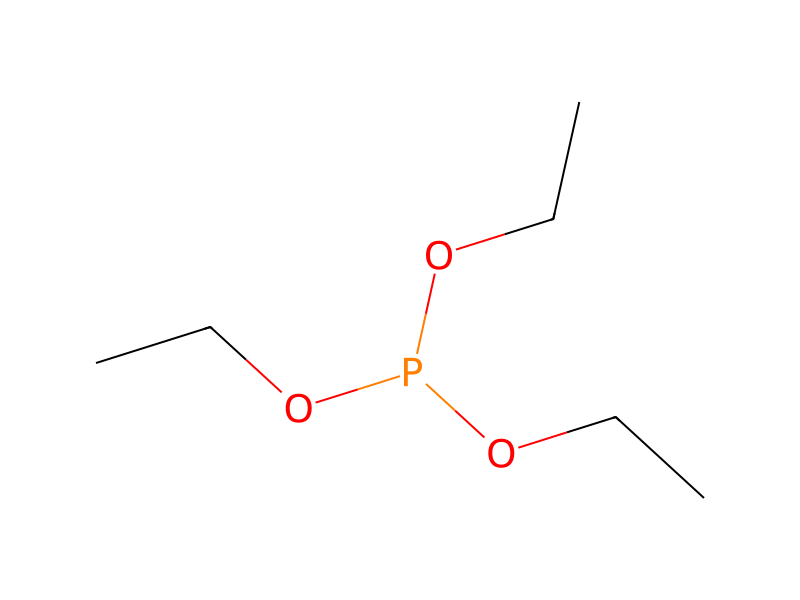
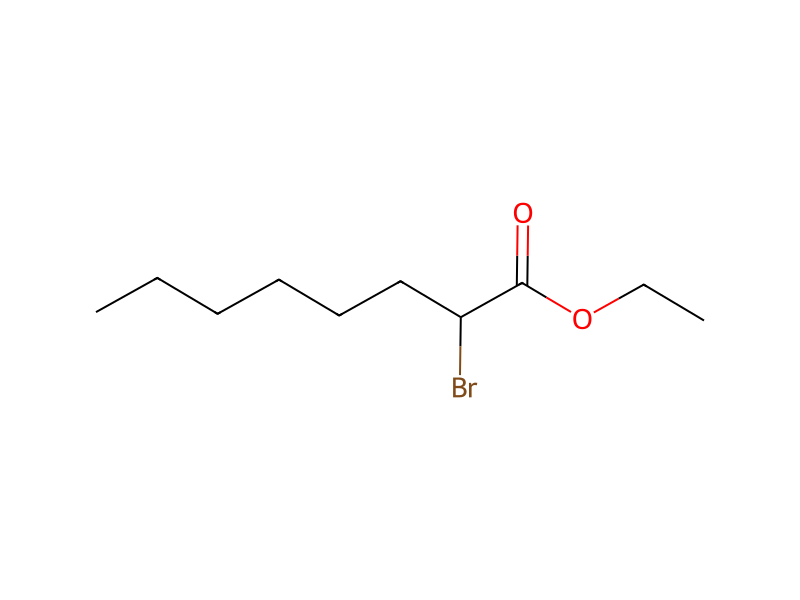
Triethyl phosphite → Octanoic acid, 2-(diethoxyphosphinyl)-, ethyl ester
Reaction equation

[CH2:1]([O:3][C:4](=[O:13])[CH:5](Br)[CH2:6][CH2:7][CH2:8][CH2:9][CH2:10][CH3:11])[CH3:2].[P:14]([O:21]CC)([O:18][CH2:19][CH3:20])[O:15][CH2:16][CH3:17]>>[CH2:1]([O:3][C:4](=[O:13])[CH:5]([P:14]([O:18][CH2:19][CH3:20])([O:15][CH2:16][CH3:17])=[O:21])[CH2:6][CH2:7][CH2:8][CH2:9][CH2:10][CH3:11])[CH3:2]Participants
3

Procedure
2-Bromo octanoic acid ethyl ester (50 g, 0.2M) was heated at 150° with triethyl phosphite (75 g, 0.44M) and the distillate, Bpt 37°-60° condensed as the temperature was raised to 200° over 6 h. The reaction mixture was cooled and distilled under high vacuum (1.00 mm Hg) to afford 2 main fractions (a) Triethyl phosphite b.p. 40°-70° and (b) 2-(diethylphosphono)octanoic acid ethyl ester (49.5 g, 0.16M); b.p. 120°-130° at 0.5 mm Hg. (Found: C, 52.9; H, 9.4. C14H29O5P+0.5H2O requires: C, 53.0; H, 9.5%; δ(CDCl3) 0.88 (3H, m, CH3); 1.32 (17H, m, (CH2)4, 3×CH3); 1.9 (2H, m, CH2); 2.92 (1H, d, d, d, J= 22 Hz, J=10 Hz; J=4 Hz, CH--P); 4.18 (6H, m, 3×CH2O).
Workup
- customthe distillate, Bpt 37°-60° condensed as the temperature
- temperaturewas raised to 200° over 6 h
- temperatureThe reaction mixture was cooled
- distillationdistilled under high vacuum (1.00 mm Hg)
Sources & evidence
- ORD record
- ord-4c4d3dfc702c40378931b8d750a5801c
- Source dataset
- uspto-grants-1986_06
- Patent number
- US04595700
Reaction notes
Loading…