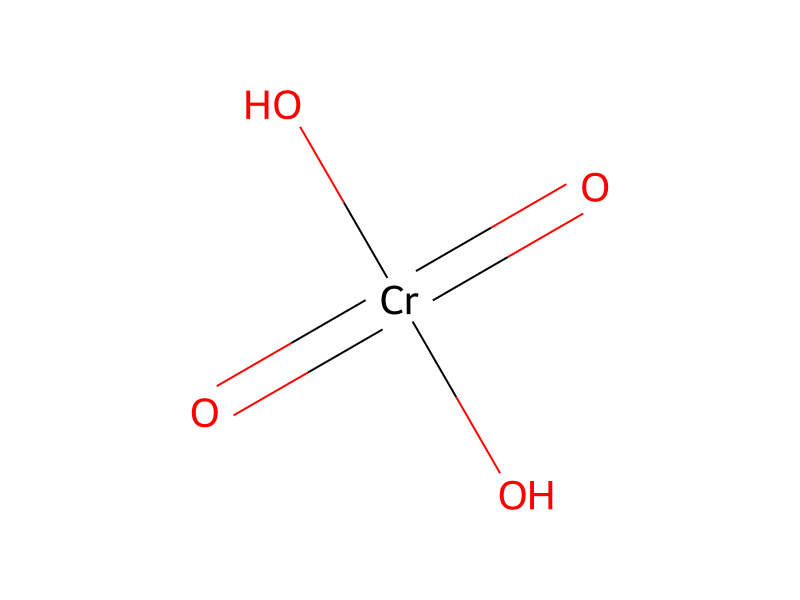
Chromic Acid → HCID 13645870, compound
Reaction equation

[C:1]([O:4][CH2:5][CH:6]1[O:11][C:10]2[C:12]([Cl:19])=[C:13]([Cl:18])[CH:14]=[C:15]([CH:16]=[O:17])[C:9]=2[O:8][CH2:7]1)(=[O:3])[CH3:2].[Cr](O)(O)(=O)=[O:21]>CC(C)=O>[C:1]([O:4][CH2:5][CH:6]1[O:11][C:10]2[C:12]([Cl:19])=[C:13]([Cl:18])[CH:14]=[C:15]([C:16]([OH:21])=[O:17])[C:9]=2[O:8][CH2:7]1)(=[O:3])[CH3:2]Participants
4
Reactant 2

Product 1

Reagents, catalysts & solvents 1

Procedure
To a solution of 1.03 g of 2-acetoxymethyl-7,8-dichloro-1,4-benzodioxane-5-carbaldehyde (Ia-a-39) in 70 ml of acetone is added 2 ml of 8N-chromic acid/sulfric acid. The mixture is stirred at room temperature for about 2.5 hours and then filtered after the confirmation by TLC that no starting material is remained. The filtrate is concentrated under reduced pressure to give a residue, which is extracted with dichloromethane. The organic layer is washed with water and evaporated to give 1.004 g (93%) of 2-acetoxymethyl-7,8-dichloro-1,4-benzodioxane-5-carboxylic acid (Ia-a-43: R3 '=Ac), which is recrystallized from dichloromethane/ether to yield crystals, m.p. 144°-145° C.
Workup
- filtrationfiltered after the confirmation by TLC that no starting material
- concentrationThe filtrate is concentrated under reduced pressure
- customto give a residue, which
- extractionis extracted with dichloromethane
- washThe organic layer is washed with water
- customevaporated
Sources & evidence
- ORD record
- ord-90cae9718e6c4d91808bfef5a7b494d4
- Source dataset
- uspto-grants-1986_06
- Patent number
- US04595767
Reaction notes
Loading…