Hydrazine → HCID 22174830, compound
Reaction equation
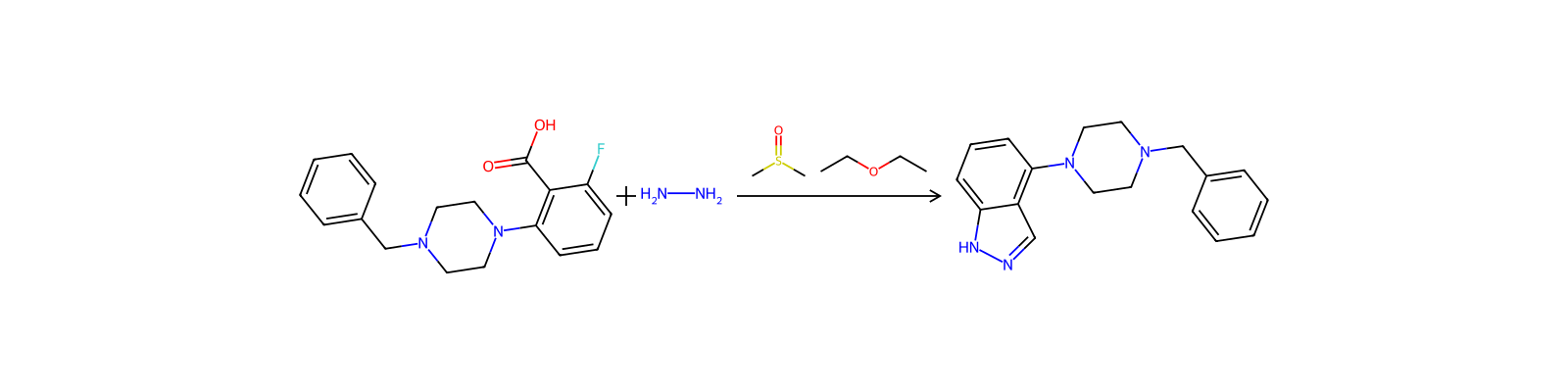
[CH2:1]([N:8]1[CH2:13][CH2:12][N:11]([C:14]2[CH:19]=[CH:18][CH:17]=[C:16](F)[C:15]=2[C:21](O)=O)[CH2:10][CH2:9]1)[C:2]1[CH:7]=[CH:6][CH:5]=[CH:4][CH:3]=1.[NH2:24][NH2:25]>CS(C)=O.CCOCC>[CH2:1]([N:8]1[CH2:13][CH2:12][N:11]([C:14]2[CH:19]=[CH:18][CH:17]=[C:16]3[C:15]=2[CH:21]=[N:24][NH:25]3)[CH2:10][CH2:9]1)[C:2]1[CH:7]=[CH:6][CH:5]=[CH:4][CH:3]=1Participants
Reactant 2


Product 1

Reagents, catalysts & solvents 2


Procedure
A stirred solution of 4-benzyl-1-(3-fluoro-2-carboxyphenyl)-piperazine (5.96 g, 20.0 mmol) in dimethylsulfoxide (10 mL) and hydrazine (10 mL) is heated at 95° C. under nitrogen for 4 days. The cooled reaction is diluted with ether and washed with a mixture of water and saturated aqueous sodium bicarbonate. The organic layer is further washed sequentially with water and brine dried over MgSO4 and concentrated in vacuo to give a residue. The residue is chromatographed using ethyl acetate as the eluant. The resulting oil is reconcentrated from ether to give a white foam which is stirred under hexanes/ether overnight. The resulting white powder is isolated by suction filtration and washed with hexane to give the title compound 3.11 g, (53% yield), identified by HNMR.
Workup
- customThe cooled reaction
- washwashed with a mixture of water and saturated aqueous sodium bicarbonate
- washThe organic layer is further washed sequentially with water and brine
- dry with materialdried over MgSO4
- concentrationconcentrated in vacuo
- customto give a residue
- customThe residue is chromatographed
- customto give a white foam which
- customThe resulting white powder is isolated by suction filtration
- washwashed with hexane
Sources & evidence
- ORD record
- ord-b3ac98d467e6449296b4bee2049a4ba3
- Source dataset
- uspto-grants-2009_06
- Patent number
- US07541370B2
Reaction notes
Loading…