2-Ethyl-1-butanol → HCID 23025343, compound
Reaction equation

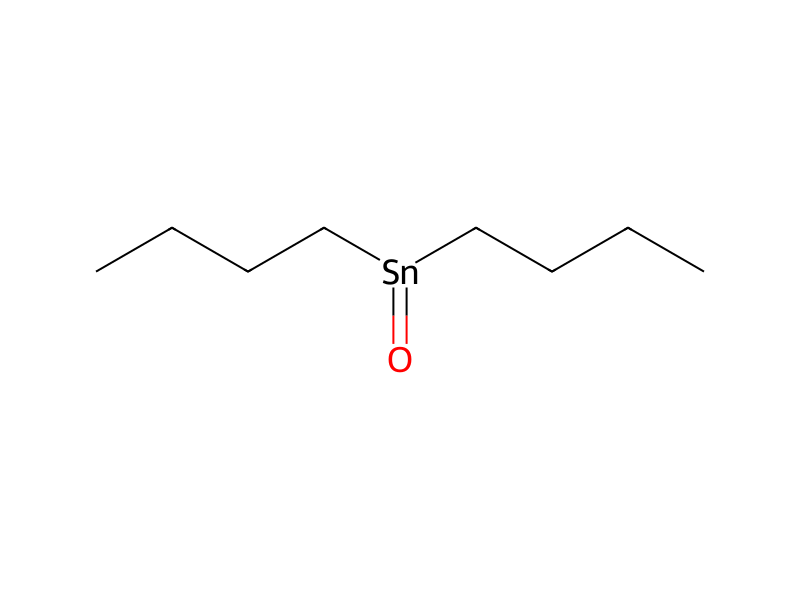
[CH2:1]([Sn:5](=[O:10])[CH2:6][CH2:7][CH2:8][CH3:9])[CH2:2][CH2:3][CH3:4].[CH2:11]([CH:13]([CH2:16][CH3:17])[CH2:14][OH:15])[CH3:12]>>[CH2:1]([Sn:5]([CH2:6][CH2:7][CH2:8][CH3:9])([O:15][CH2:14][CH:13]([CH2:16][CH3:17])[CH2:11][CH3:12])[O:10][Sn:5]([CH2:6][CH2:7][CH2:8][CH3:9])([CH2:1][CH2:2][CH2:3][CH3:4])[O:15][CH2:14][CH:13]([CH2:16][CH3:17])[CH2:11][CH3:12])[CH2:2][CH2:3][CH3:4]Participants


Procedure
A 500 ml recovery flask was charged with 59.8 g (0.15 mol) of dibutyltin oxide (manufactured by Aldrich Chemical Co., U.S.A., 98%) and 122 g (1.2 mol) of 2-ethyl-1-butanol (manufactured by Aldrich Chemical Co., U.S.A., 98%), whereby the flask contained the resulting white slurry mixture. The flask was attached to an evaporator (manufactured by Shibata Scientific Technology Ltd., Japan, R-144) connected to a thermoregulator-equipped oil bath (manufactured by Masuda Corporation, Japan, OBH-24), a vacuum pump (manufactured by ULVAC Inc., Japan, G-50A), and a vacuum controller (manufactured by Okano Works Ltd., Japan, VC-10S). The oil bath temperature was set at 140° C. The flask was immersed in the oil bath, whereupon rotation of the evaporator was started. Rotation was continued for about 30 minutes while stirring and heating under atmospheric pressure with the evaporator purge valve open. The evaporator purge valve was then closed, and the pressure in the system was gradually lowered to about 70 kPa using the vacuum pump and the vacuum controller. This state was maintained for 1 hour, after which the flask was removed from the oil bath. The reactant had turned a transparent liquid. The purge valve was gradually opened to return the system pressure to atmospheric pressure. The distillate was 3.6 g, transparent and had separated into 2 layers. Analysis of the distillate showed a water content of about 2.2 g. The flask was then removed from the oil bath and the purge valve was gradually opened to return the system pressure to atmospheric pressure. The flask yielded 175 g of reaction solution. Results of 119Sn, 1H and 13C-NMR analysis showed that, using dibutyltin oxide as a reference, the reaction solution contained about an 99% yield of 1,1,3,3-tetrabutyl-1,3-bis(2-ethyl-butyloxy)-distannoxane.
Workup
- customThe flask was attached to an evaporator (manufactured by Shibata Scientific Technology Ltd., Japan, R-144)
- customconnected to a thermoregulator-equipped oil bath
- customwas set at 140° C
- customThe flask was immersed in the oil bath, whereupon rotation of the evaporator
- temperatureheating under atmospheric pressure with the evaporator
- custompurge valve open
- customThe evaporator
- custompurge valve
- customwas then closed
- temperatureThis state was maintained for 1 hour
- customafter which the flask was removed from the oil bath
- customtransparent and had separated into 2 layers
- customThe flask was then removed from the oil bath
- customThe flask yielded
- custom175 g of reaction solution
- customResults of 119Sn, 1H and 13C-NMR analysis
Sources & evidence
- ORD record
- ord-ca4d1885dbbb4001893f5e1026da8f98
- Source dataset
- uspto-grants-2009_06
- Patent number
- US07541482B2
Reaction notes
Loading…