Tetrabutylammonium Hydroxide → 13-cyclohexyl-N-((dimethylamino)sulfonyl)-3-methoxy-6-(4-((3-methyl-3,8-diazabicyclo[3.2.1]oct-8-yl)carbonyl)-1,3-oxazol-2-yl)-7H-indolo[2,1-a][2]benzazepine-10-carboxamide
Reaction equation

[CH:1]1([C:7]2[C:8]3[CH:9]=[CH:10][C:11]([C:37](=[O:45])[NH:38][S:39]([N:42]([CH3:44])[CH3:43])(=[O:41])=[O:40])=[CH:12][C:13]=3[N:14]3[CH2:20][C:19]([C:21]4[O:22][CH:23]=[C:24]([C:26](OCC)=[O:27])[N:25]=4)=[CH:18][C:17]4[CH:31]=[C:32]([O:35][CH3:36])[CH:33]=[CH:34][C:16]=4[C:15]=23)[CH2:6][CH2:5][CH2:4][CH2:3][CH2:2]1.[OH-].C([N+](CCCC)(CCCC)CCCC)CCC.CN(C(ON1N=NC2C=CC=CC1=2)=[N+](C)C)C.[B-](F)(F)(F)F.Cl.Cl.[CH3:88][N:89]1[CH2:95][CH:94]2[NH:96][CH:91]([CH2:92][CH2:93]2)[CH2:90]1>C1COCC1.CO.CN(C=O)C.CN(C1C=CN=CC=1)C.O>[CH:1]1([C:7]2[C:8]3[CH:9]=[CH:10][C:11]([C:37]([NH:38][S:39]([N:42]([CH3:44])[CH3:43])(=[O:40])=[O:41])=[O:45])=[CH:12][C:13]=3[N:14]3[CH2:20][C:19]([C:21]4[O:22][CH:23]=[C:24]([C:26]([N:96]5[CH:91]6[CH2:92][CH2:93][CH:94]5[CH2:95][N:89]([CH3:88])[CH2:90]6)=[O:27])[N:25]=4)=[CH:18][C:17]4[CH:31]=[C:32]([O:35][CH3:36])[CH:33]=[CH:34][C:16]=4[C:15]=23)[CH2:6][CH2:5][CH2:4][CH2:3][CH2:2]1Participants
Reactant 4
 HCID 2723671Tetrabutylammonium Hydroxide
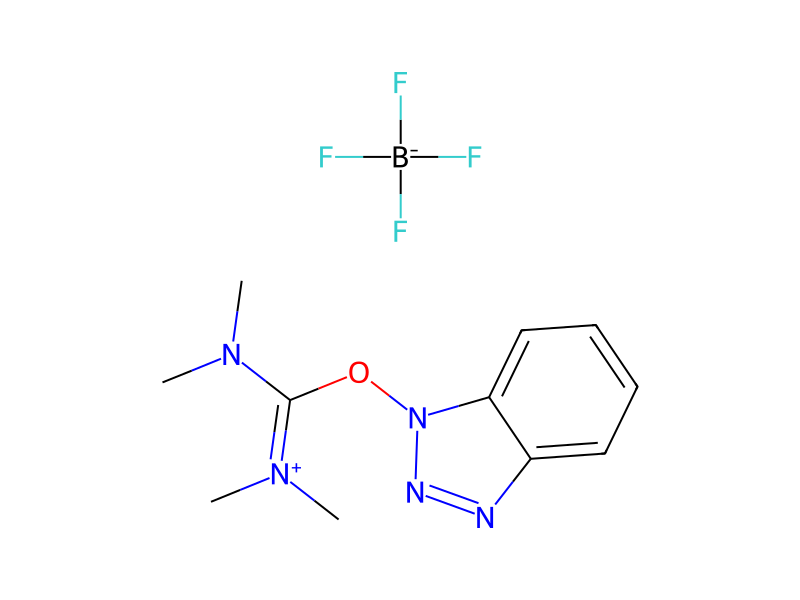 HCID 2733207O-(Benzotriazol-1-yl)-N,N,N',N'-tetramethyluronium tetrafluoroborate
 HCID 229243503-Methyl-3,8-diazabicyclo(3.2.1)octane--hydrogen chloride (1/2)
 HCID 59133915Ethyl 2-(13-cyclohexyl-10-(((dimethylamino)sulfonyl)carbamoyl)-3-methoxy-7H-indolo[2,1-a][2]benzazepin-6-yl)-1,3-oxazole-4-carboxylate
Product 1

Reagents, catalysts & solvents 5





Procedure
Ethyl 2-(13-cyclohexyl-10-(((dimethylamino)sulfonyl)carbamoyl)-3-methoxy-7H-indolo[2,1-a][2]benzazepin-6-yl)-1,3-oxazole-4-carboxylate (35.7 mg, 0.056 mMol) was dissolved in 0.6 ml of THF in a 2 dram vial. Tetrabutylammonium hydroxide (170 uL, 0.17 mMol) as a 1M solution in methanol was added to the reaction. The reaction was capped and stirred for 3 hrs at room temperature. The reaction was partitioned between 1N hydrochloric acid and dichloromethane. The organic phase was washed with 1N hydrochloric acid and dried over sodium sulfate. The material was concentrated to dryness, dried in vacuuo and used without further purification. The hydrolysis product (0.056 mMol) was dissolved in 1 mL of DMF and TBTU (39 mg, 0.12 mMol) added. The reaction was stirred at room temperature under nitrogen for approximately 50 minutes then add DMAP (37.9 mg, 0.31 mMol) was added followed by 3-methyl-3,8-diaza-bicyclo[3.2.1]octane dihydrochloride (23 mg, 0.11 mMol). The reaction was stirred for 4 hrs at room temperature under nitrogen atmosphere until complete, then added to 20 mL of water and extracted with dichloromethane, washed organic layer with water and dry over sodium sulfate to yield 50 mg of crude product. The product was purified by Prep HPLC under the following conditions: Shimadzu preparative HPLC using Discovery VP software: % A=10% acetonitrile, 90% water, 0.1% TFA % B=90% acetonitrile, 10% water, 0.1% TFA; Initial % B=30; Final % B=100; Gradient=12 min; Runtime=20 min; Flow rate=25 ml/min; Wavelength=220 nm; Column=Waters Sunfire 19 mm×100 mm. Product retention time=6.1 min. Product fractions were concentrated in vacuuo to yield 30.5 mg of the title compound as a trifluoroacetic acid salt. 1H NMR (500 MHz, CHLOROFORM-D) δ ppm 1.09-1.30 (m, 1H) 1.31-1.61 (m, 3H) 1.68-1.85 (m, 2H) 1.87-2.20 (m, 5H) 2.26-2.44 (m, 2H) 2.51-2.66 (m, 1H) 2.77-2.90 (m, 1H) 2.91-3.01 (m, 3H) 3.04 (s, 6H) 3.12 (d, J=11.90 Hz, 1H) 3.23 (d, J=11.60 Hz, 1H) 3.78 (d, J=12.21 Hz, 1H) 3.94 (s, 3H) 4.24 (d, J=13.12 Hz, 1H) 4.43 (d, J=14.34 Hz, 1H) 5.01 (d, J=5.80 Hz, 1H) 5.13-5.47 (m, 1H) 5.85 (d, J=14.04 Hz, 1H) 6.02 (s, 1H) 7.03 (d, J=2.75 Hz, 1H) 7.12 (dd, J=8.70, 2.59 Hz, 1H) 7.25-7.32 (m, 1H) 7.56 (d, J=8.55 Hz, 1H) 7.69 (s, 1H) 7.88 (d, J=8.24 Hz, 1H) 8.18 (s, 1H) 8.28 (s, 1H) 8.52 (s, 1H) 11.72 (s, 1H); LC-MS: Shimadzu Analytical HPLC using Discovery VP software: % A=5% acetonitrile, 95% water, 10 mmol Ammonium Acetate % B=95% acetonitrile, 5% water, 10 mmol Ammonium Acetate; Initial % B=0; Final % B=100; Gradient=2 min; Runtime=3 min; Flow rate=5 ml/min; Wavelength=220 nm; Column=Phenomenex Luna 3.0 mm×50 mm S10 Retention Time=1.7 min, MS m/z 711 (MH−), m/z 713 (MH+).
Workup
- customThe reaction was capped
- customThe reaction was partitioned between 1N hydrochloric acid and dichloromethane
- washThe organic phase was washed with 1N hydrochloric acid
- dry with materialdried over sodium sulfate
- concentrationThe material was concentrated to dryness
- customdried in vacuuo
- customused without further purification
- stirringThe reaction was stirred at room temperature under nitrogen for approximately 50 minutes
- stirringThe reaction was stirred for 4 hrs at room temperature under nitrogen atmosphere until complete,
- extractionextracted with dichloromethane
- washwashed organic layer with water
- dry with materialdry over sodium sulfate
- customto yield 50 mg of crude product
- customThe product was purified by Prep HPLC under the following conditions
- customGradient=12 min
- customRuntime=20 min
- concentrationProduct fractions were concentrated in vacuuo
Sources & evidence
- ORD record
- ord-87f244e74c7d46fd872e4395bb89c664
- Source dataset
- uspto-grants-2010_01
- Patent number
- US07652004B2
Reaction notes
Loading…