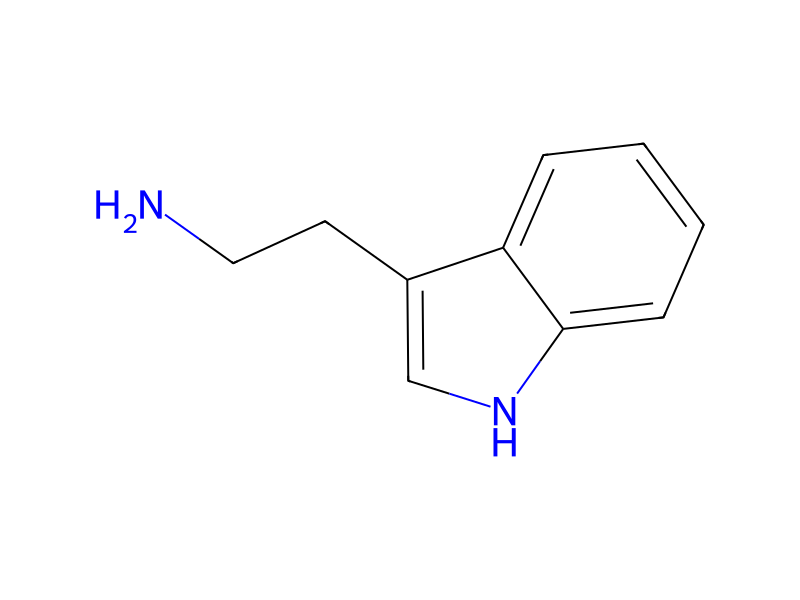
Benzylamine → Tryptamine
Reaction equation

C([NH:8][CH2:9][CH2:10][C:11]1[C:19]2[C:14](=[CH:15][CH:16]=[C:17](OCC3C=CC=CC=3)[CH:18]=2)[NH:13][CH:12]=1)C1C=CC=CC=1.C(N)C1C=CC=CC=1.[H-].[Al+3].[Li+].[H-].[H-].[H-].N1(C(=O)C2N(CCCBr)C=NC=2N(C)C1=O)C.C(=O)([O-])[O-].[K+].[K+]>>[NH2:8][CH2:9][CH2:10][C:11]1[C:19]2[C:14](=[CH:15][CH:16]=[CH:17][CH:18]=2)[NH:13][CH:12]=1Participants





Procedure
N-Benzyl-5-benzyloxytryptamine, which can be prepared by the procedure of Speeter and Anthony, J.A.C.S., 76, 6208 (1954) by reacting 5-benzyloxy-3-indol-glyoxylyl chloride with benzylamine and reducing the product with lithium aluminium hydride, is reacted with 3-(theophyllin-7-yl)propyl bromide in the presence of a weak base such as potassium carbonate to yield N-benzyl-5-benzyloxy-N-[3-theophyllin-7-yl)propyl]tryptamine. Debenzylation by hydrogenation in the presence of a platinum catalyst gives the desired compound. By starting from 5-acetoxy-3-indolglyoxylyl chloride instead of 5-benzylox-3-indol-glyoxylyl chloride and proceeding in analogous manner 5-acetoxy-N-[3-(theophyllin-7-yl)propyl]tryptamine is prepared. Treatment of this compound with ammonia solution to remove the acetyl group gives the desired compound.
Sources & evidence
- ORD record
- ord-38074a6e86874bcf96b42f267715cd61
- Source dataset
- uspto-grants-1983_09
- Patent number
- US04406903
Reaction notes
Loading…