2-Bromo-6-methylpyridine → HCID 67207195, compound
Reaction equation

Cl.[C:2]([N:5]1[C:14]2[C:9](=[CH:10][C:11]([C:15]#[C:16][Si:17]([CH:24]([CH3:26])[CH3:25])([CH:21]([CH3:23])[CH3:22])[CH:18]([CH3:20])[CH3:19])=[CH:12][CH:13]=2)[C@H:8]([NH2:27])[CH2:7][C@@H:6]1[CH3:28])(=[O:4])[CH3:3].CC(C)([O-])C.[Na+].C[N:36]([CH3:62])[C:37]1[CH:42]=[CH:41][CH:40]=C[C:38]=1C1C=CC=CC=1P(C1CCCCC1)C1CCCCC1.BrC1C=CC=C(C)N=1>C1C=CC(/C=C/C(/C=C/C2C=CC=CC=2)=O)=CC=1.C1C=CC(/C=C/C(/C=C/C2C=CC=CC=2)=O)=CC=1.C1C=CC(/C=C/C(/C=C/C2C=CC=CC=2)=O)=CC=1.[Pd].[Pd].C1(C)C=CC=CC=1>[C:2]([N:5]1[C:14]2[C:9](=[CH:10][C:11]([C:15]#[C:16][Si:17]([CH:21]([CH3:23])[CH3:22])([CH:18]([CH3:20])[CH3:19])[CH:24]([CH3:26])[CH3:25])=[CH:12][CH:13]=2)[C@H:8]([NH:27][C:62]2[CH:40]=[CH:41][CH:42]=[C:37]([CH3:38])[N:36]=2)[CH2:7][C@@H:6]1[CH3:28])(=[O:4])[CH3:3]Participants
Reactant 4



Product 1

Reagents, catalysts & solvents 2


Conditions
- Temperature
- 100 °C
Procedure
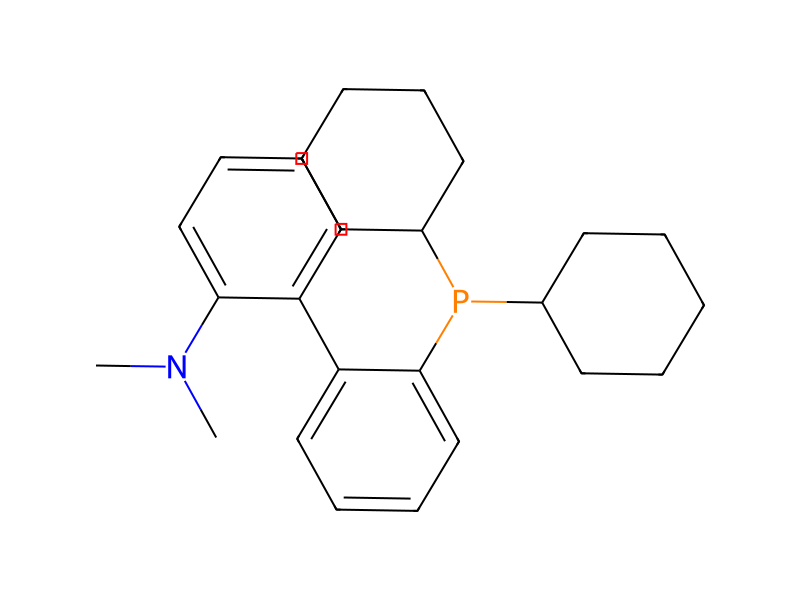
A flask was charged with (2S,4R)-1-acetyl-2-methyl-6-{[tris(1-methylethyl)silyl]ethynyl}-1,2,3,4-tetrahydro-4-quinolinamine hydrochloride (for a preparation see Intermediate 108) (200 mg, 0.475 mmol), sodium tert-butoxide (228 mg, 2.375 mmol), tris(dibenzylideneacetone)dipalladium(0) (435 mg, 0.475 mmol) and 2-(dimethylamino)-2′-(dicyclohexylphosphino)biphenyl (DavePhos) (374 mg, 0.950 mmol) then filled with degassed toluene (6 mL) and the resulting mixture was treated with 2-bromo-6-methylpyridine (0.162 mL, 1.425 mmol) then stirred at 100° C. under nitrogen for 1.5 h then cooled to room temperature and partitioned between water and AcOEt. The two layers were filtered through celite then separated. The aqueous phase was extracted with AcOEt and the combined organic phases were washed with water then brine, dried over MgSO4 and concentrated in vacuo. Purification of the residue by SP4 using a 25 G silica cartridge (gradient:13 to 63% AcOEt in Hexanes) gave (2S,4R)-1-acetyl-2-methyl-N-(6-methyl-2-pyridinyl)-6-{[tris(1-methylethyl)silyl]ethynyl}-1,2,3,4-tetrahydro-4-quinolinamine (280 mg, 0.589 mmol, 124% yield) contaminated with palladium ligand residues as a brown foam which was used in the next step without further purification.
Workup
- temperaturethen cooled to room temperature
- custompartitioned between water and AcOEt
- filtrationThe two layers were filtered through celite
- customthen separated
- extractionThe aqueous phase was extracted with AcOEt
- washthe combined organic phases were washed with water
- dry with materialbrine, dried over MgSO4
- concentrationconcentrated in vacuo
- customPurification of the residue by SP4
Sources & evidence
- ORD record
- ord-7df87f819aa94db0afb07f6dbfe29653
- Source dataset
- uspto-grants-2013_11
- Patent number
- US08580957B2
Reaction notes
Loading…