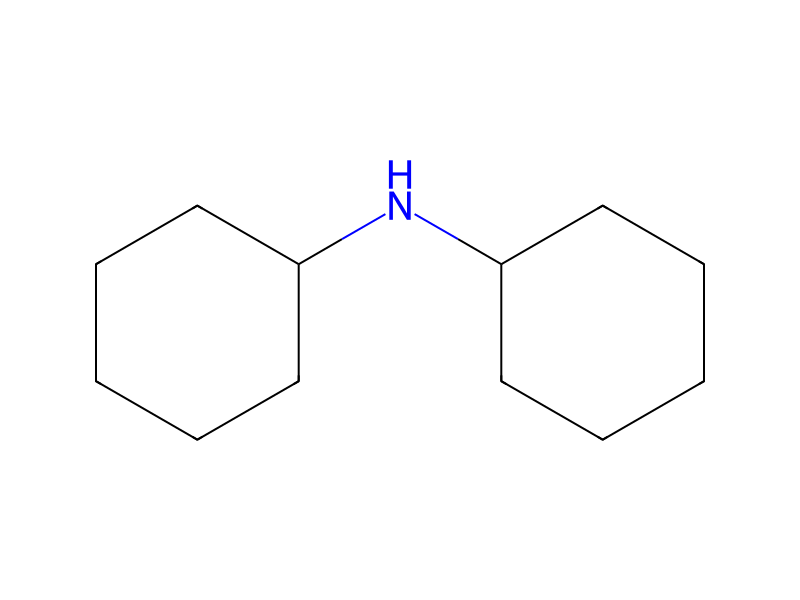
Dicyclohexylamine → HCID 20342937, compound
Reaction equation

C1(NC2CCCCC2)CCCCC1.C1(NC2CCCCC2)CCCCC1.[Br:27][C:28]1[CH:47]=[C:46]2[C:31]([NH:32][CH:33]=[C:34]2[CH2:35][CH:36]([C:43]([OH:45])=[O:44])[NH:37][C:38](=[O:42])[CH2:39][CH2:40][SH:41])=[CH:30][CH:29]=1>C(#N)C>[Br:27][C:28]1[CH:47]=[C:46]2[C:31]([NH:32][CH:33]=[C:34]2[CH2:35][CH:36]([C:43]([OH:45])=[O:44])[NH:37][C:38](=[O:42])[CH2:39][CH2:40][SH:41])=[CH:30][CH:29]=1Participants
4
Reactant 2

Product 1

Reagents, catalysts & solvents 1

Procedure
The 130 mg. of material that remains in the flask is dissolved in acetonitrile and treated with 1 equivalent of dicyclohexylamine. After standing several hours, the precipitate is filtered off and dried at 40° 1 mm to yield 200 mg. of 5-bromo-N-(3-mercapto-1-oxopropyl)-DL-tryptophan dicyclohexylamine salt; m.p. 198°-201°.
Workup
- waitAfter standing several hours
- filtrationthe precipitate is filtered off
- customdried at 40° 1 mm
- customto yield 200 mg
Sources & evidence
- ORD record
- ord-9ca4cd870e1a497dabf529780f23e265
- Source dataset
- uspto-grants-1980_04
- Patent number
- US04199512
Reaction notes
Loading…