1-Bromo-3-methylbutane → 1-Bromo-4-isopentylthiobenzene
Reaction equation

[Br:1][C:2]1[CH:7]=[CH:6][C:5]([SH:8])=[CH:4][CH:3]=1.[OH-].[Na+].Br[CH2:12][CH2:13][CH:14]([CH3:16])[CH3:15]>CC(C)=O>[CH3:15][CH:14]([CH3:16])[CH2:13][CH2:12][S:8][C:5]1[CH:6]=[CH:7][C:2]([Br:1])=[CH:3][CH:4]=1Participants
Reactant 3
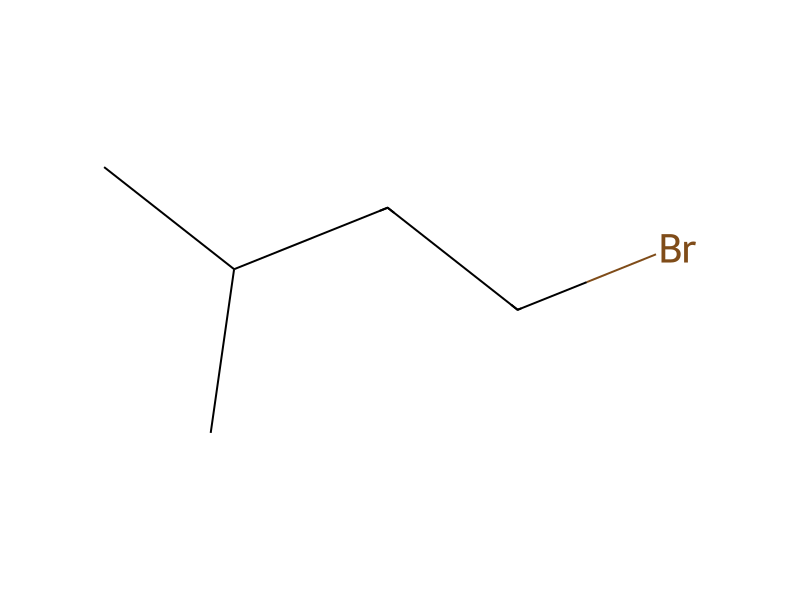


Product 1

Reagents, catalysts & solvents 1

Procedure
A mixture of 15 g (79 mmol) of 4-bromo-thiophenol (Compound 40), 3.16 g (79 mmol) of powdered sodium hydroxide and 150 ml of acetone was heated at reflux for 15 minutes. The refluxing mixture was then treated dropwise with a solution of 12 g (79 mmol) of 1-bromo-3-methylbutane (Compound 49) in 25 ml of acetone and then refluxed for a further 18 hours. The mixture was allowed to cool and the solvent removed in-vacuo. The residue was taken up in 25 ml of water and the mixture basified with 2 N NaOH solution. The mixture was extracted with ether and the combined ether extracts washed successively with 1 N NaOH, water and saturated NaCl and then dried (MgSO4). The solvent was removed in-vacuo and the residue distilled (113-117 degrees C., 0.2 mm) to give the title compound as a colourless oil. PMR (CDCl3): & 0.93 (6H, d, J~6.6 Hz), 1.47-1.58 (2H, m), 1.65-1.80 (1H, m), 2.90 (2H, t, J~7.8 Hz), 7.18 (2H, d, J~8.6 Hz), 7.39 (2H, d, J~8.6 Hz).
Workup
- temperaturewas heated
- temperatureat reflux for 15 minutes
- temperaturerefluxed for a further 18 hours
- temperatureto cool
- customthe solvent removed in-vacuo
- extractionThe mixture was extracted with ether
- washthe combined ether extracts washed successively with 1 N NaOH, water and saturated NaCl
- dry with materialdried (MgSO4)
- customThe solvent was removed in-vacuo
- distillationthe residue distilled (113-117 degrees C., 0.2 mm)
Sources & evidence
- ORD record
- ord-bd61c995ad644bbc881036d8a31573eb
- Source dataset
- uspto-grants-1991_05
- Patent number
- US05013744
Reaction notes
Loading…