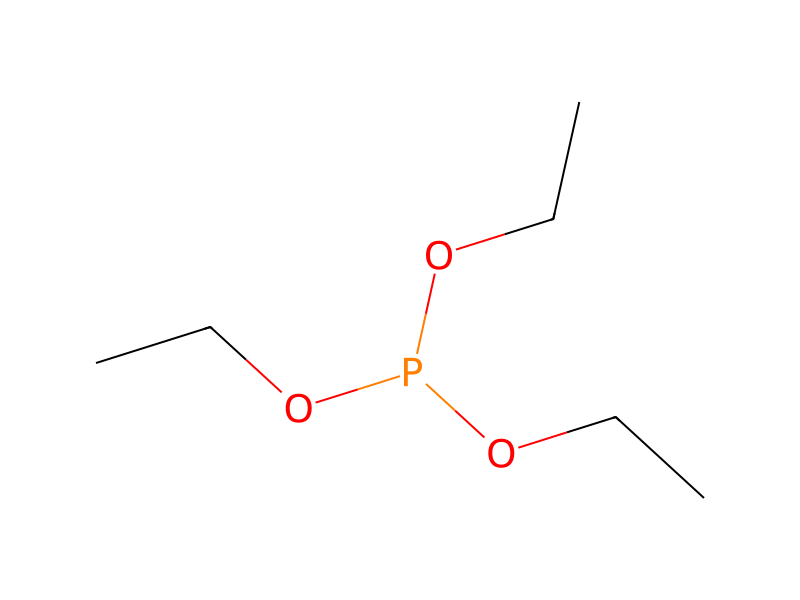
Triethyl phosphite → Fosarilate
Reaction equation

[Cl:1][C:2]1[CH:15]=[C:14]([O:16][CH3:17])[CH:13]=[CH:12][C:3]=1[O:4][CH2:5][CH2:6][CH2:7][CH2:8][CH2:9][CH2:10]Br.[P:18]([O:25]CC)([O:22][CH2:23][CH3:24])[O:19][CH2:20][CH3:21]>>[Cl:1][C:2]1[CH:15]=[C:14]([O:16][CH3:17])[CH:13]=[CH:12][C:3]=1[O:4][CH2:5][CH2:6][CH2:7][CH2:8][CH2:9][CH2:10][P:18](=[O:25])([O:22][CH2:23][CH3:24])[O:19][CH2:20][CH3:21]Participants
3


Procedure
A mixture of 10 g (0.0313 mole) of 6-(2-chloro-4-methoxyphenoxy)hexyl bromide and 5.2 g (0.313 mole) of triethyl phosphite was heated at 180°-190° C. for two hours. The reaction mixture was distilled in vacuo, and the fraction (4.6 g) collected at 183°-185° C. (0.03 mm) was redistilled to give 3.6 g of diethyl [6-(2-chloro-4-methoxyphenoxy)hexyl]phosphonate, b.p. 195°-197° C. (0.005 mm).
Workup
- temperaturewas heated at 180°-190° C. for two hours
- distillationThe reaction mixture was distilled in vacuo
- customthe fraction (4.6 g) collected at 183°-185° C. (0.03 mm)
- distillationwas redistilled
Sources & evidence
- ORD record
- ord-96443e83b12e44008ac70a783e59376d
- Source dataset
- uspto-grants-1980_01
- Patent number
- US04182759
Reaction notes
Loading…