Phenyl isocyanate → HCID 20185704, compound
Reaction equation

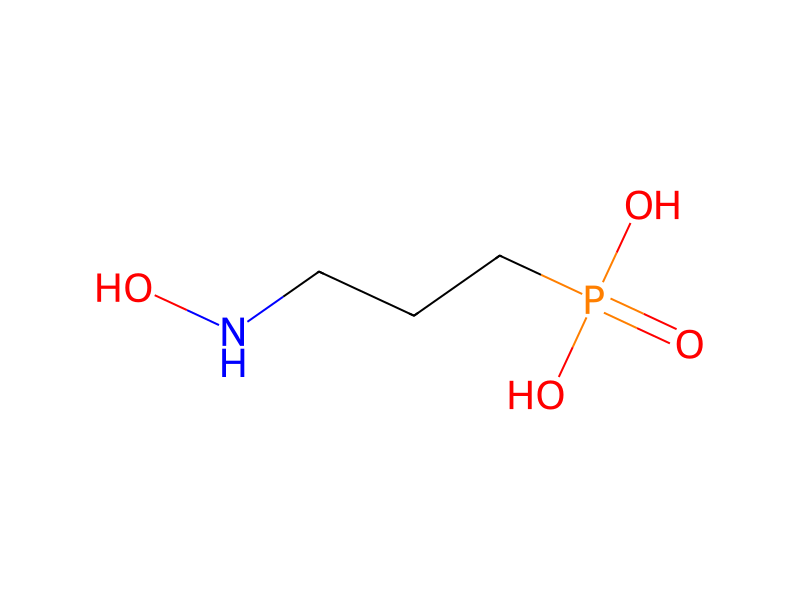
[OH:1][NH:2][CH2:3][CH2:4][CH2:5][P:6](=[O:9])([OH:8])[OH:7].C[Si](C([Si](C)(C)C)C(N)=O)(C)C.[C:22]1([N:28]=[C:29]=[O:30])[CH:27]=[CH:26][CH:25]=[CH:24][CH:23]=1>ClCCl>[OH:1][N:2]([CH2:3][CH2:4][CH2:5][P:6](=[O:8])([OH:7])[OH:9])[C:29](=[O:30])[NH:28][C:22]1[CH:27]=[CH:26][CH:25]=[CH:24][CH:23]=1Participants
Reactant 3


Product 1

Reagents, catalysts & solvents 1

Procedure
A mixture of 3-(N-hydroxyamino)propylphosphonic acid (1.64 g), dichloromethane (30 ml) and bis(trimethylsilyl)acetamide (10 g) was stirred at ambient temperature for 3 hours. The mixture was cooled to 0-5° C. and phenyl isocyanate (1.80 g) was added thereto. The reaction mixture was stirred at the same temperature for an hour and at ambient temperature for 3 hours and then allowed to stand overnight. The resultant mixture was concentrated under reduced pressure. To the residue was added water (60 ml), and then the mixture was stirred at ambient temperature for 3 hours. Insoluble materials were removed by filtration and the filtrate was washed twice with ethyl acetate (50 ml). To the aqueous layer was added an additional 90 ml of water, whereafter the aqueous solution was subjected to a column chromatography using activated charcoal. The object compound was eluted with 70% aqueous acetone. The eluate was evaporated to dryness under reduced pressure, whereafter the resulting crystals were washed with acetone and dried to give crystalline 3-(N-hydroxy-N-phenylcarbamoylamino)propylphosphonic acid (1.13 g). Mp 126-130° C. (dec.)
Workup
- temperatureThe mixture was cooled to 0-5° C.
- stirringThe reaction mixture was stirred at the same temperature for an hour and at ambient temperature for 3 hours
- waitto stand overnight
- concentrationThe resultant mixture was concentrated under reduced pressure
- additionTo the residue was added water (60 ml)
- stirringthe mixture was stirred at ambient temperature for 3 hours
- customInsoluble materials were removed by filtration
- washthe filtrate was washed twice with ethyl acetate (50 ml)
- additionTo the aqueous layer was added an additional 90 ml of water
- washThe object compound was eluted with 70% aqueous acetone
- customThe eluate was evaporated to dryness under reduced pressure, whereafter the resulting crystals
- washwere washed with acetone
- customdried
Sources & evidence
- ORD record
- ord-5a88b08c358b4c1e844546b95af107fb
- Source dataset
- uspto-grants-1980_01
- Patent number
- US04182758
Reaction notes
Loading…