1,2-Dichloro-4-nitrobenzene → Methyl 2-[4-(2-chloro-4-nitrophenoxy)phenoxy]propanoate
Reaction equation
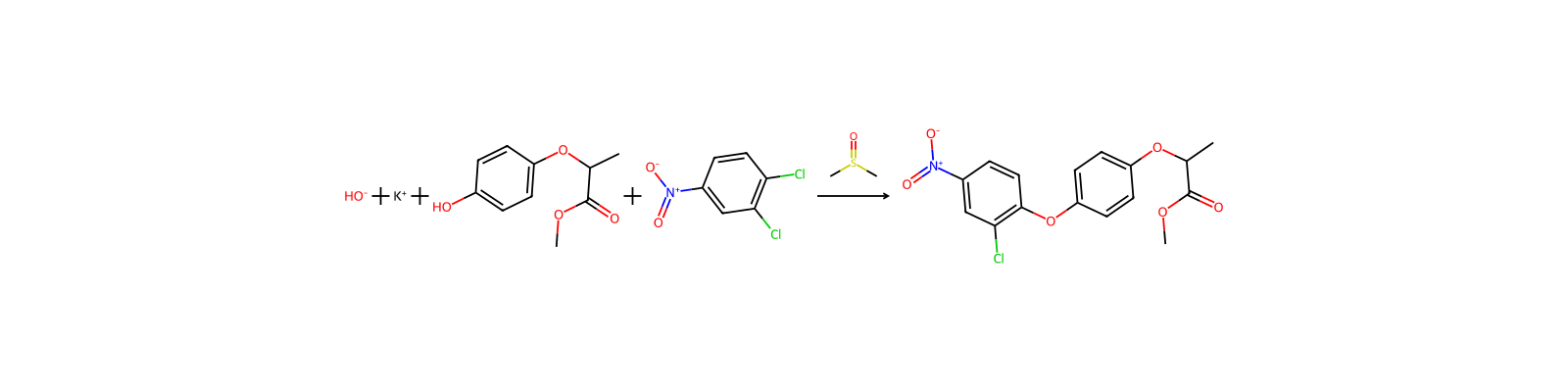
[OH-].[K+].[OH:3][C:4]1[CH:16]=[CH:15][C:7]([O:8][CH:9]([CH3:14])[C:10]([O:12][CH3:13])=[O:11])=[CH:6][CH:5]=1.[Cl:17][C:18]1[CH:19]=[C:20]([N+:25]([O-:27])=[O:26])[CH:21]=[CH:22][C:23]=1Cl>CS(C)=O>[Cl:17][C:18]1[CH:19]=[C:20]([N+:25]([O-:27])=[O:26])[CH:21]=[CH:22][C:23]=1[O:3][C:4]1[CH:5]=[CH:6][C:7]([O:8][CH:9]([CH3:14])[C:10]([O:12][CH3:13])=[O:11])=[CH:15][CH:16]=1Participants
5





Procedure
6.5 g of pulverised potassium hydroxide and 20 g of methyl 4-hydroxy-α-phenoxypropionate in 250 ml of dry dimethyl sulphoxide are charged at 0° C. into a three-necked flask. With stirring, and at a temperature between 0° and 5° C., 19.5 g of 3,4-dichloro-nitrobenzene are added by small amounts and stirring is continued for 12 hours at room temperature. Thereafter the reaction mixture is poured into ice-water and extracted with ethyl acetate. The extract is dried over sodium sulphate and the solvent distilled off to yield an oily product which is then subjected to high vacuum distillation. The resultant substance, viz. methyl 4-(2'-chloro-4'-nitrophenoxy)-α-phenoxypropionate (yield 27 g), boils at 194° C./0.01 Torr (compound 1).
Workup
- stirringstirring
- extractionextracted with ethyl acetate
- dry with materialThe extract is dried over sodium sulphate
- distillationthe solvent distilled off
- customto yield an oily product which
- distillationis then subjected to high vacuum distillation
Sources & evidence
- ORD record
- ord-2b2c3252d8e94c129613a018ee39ede4
- Source dataset
- uspto-grants-1980_01
- Patent number
- US04183743
Reaction notes
Loading…