Pyridine → 4-Acrylamido-2-bromothiazole
Reaction equation
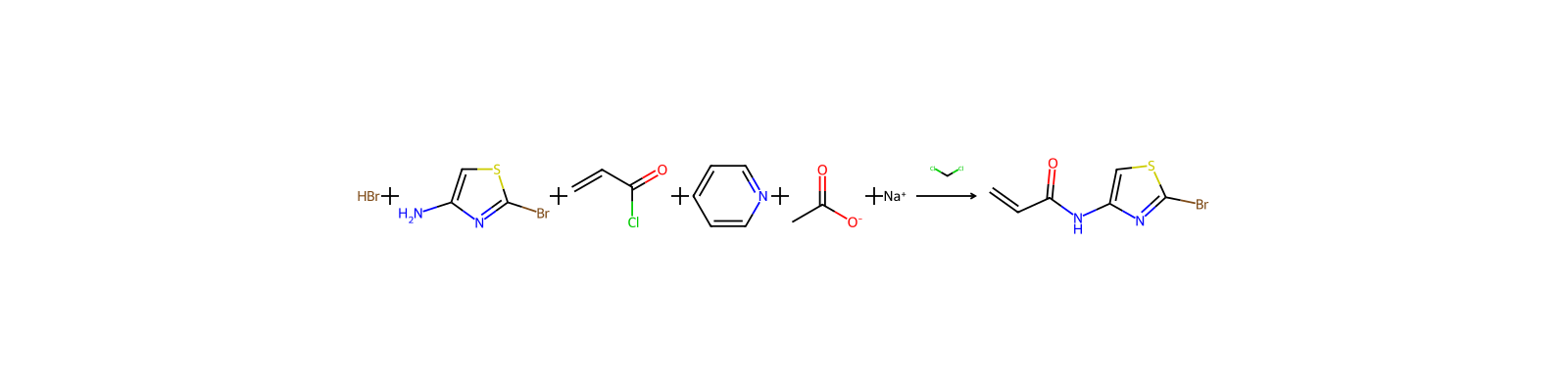
Br.[NH2:2][C:3]1[N:4]=[C:5]([Br:8])[S:6][CH:7]=1.[C:9](Cl)(=[O:12])[CH:10]=[CH2:11].N1C=CC=CC=1.C([O-])(=O)C.[Na+]>C(Cl)Cl>[C:9]([NH:2][C:3]1[N:4]=[C:5]([Br:8])[S:6][CH:7]=1)(=[O:12])[CH:10]=[CH2:11]Participants





Procedure
4-Amino-2-bromothiazole hydrobromide (15.6g) and acryloylchloride (7g) were suspended in methylene chloride (100 ml) with stirring and treated with pyridine (16 ml.), maintaining reaction temperature at 0° C. with an ice bath. After addition was complete, the reaction mixture was stirred at room temperature for 3 hours, then poured onto 20% aqueous sodium acetate and stirred for 30 minutes. The mixture was filtered and separated and the organic layer washed with 2N hydrochloric acid, water, sodium carbonate solution and water. The organic layer was dried (MgSO4) and the solvent removed in vacuo. The residue was recrystallised from carbon tetrachloride to give the title compound (0.7 g) m.p. 152°-4° C. (Found: C, 30.5; H, 2.2; N, 11.8. C6H5BrN2OS requires C, 30.9; H, 2.2; N, 12.0%).
Workup
- temperaturemaintaining
- customreaction temperature at 0° C. with an ice bath
- additionAfter addition
- stirringthe reaction mixture was stirred at room temperature for 3 hours
- stirringstirred for 30 minutes
- filtrationThe mixture was filtered
- customseparated
- washthe organic layer washed with 2N hydrochloric acid, water, sodium carbonate solution and water
- dry with materialThe organic layer was dried (MgSO4)
- customthe solvent removed in vacuo
- customThe residue was recrystallised from carbon tetrachloride
Sources & evidence
- ORD record
- ord-c6dc039c75bf4a7491da6f36215a81ea
- Source dataset
- uspto-grants-1980_01
- Patent number
- US04183854
Reaction notes
Loading…