Benzylamine → 3-Benzyl-3-azabicyclo(3.1.0)hexane-2,4-dione
Reaction equation
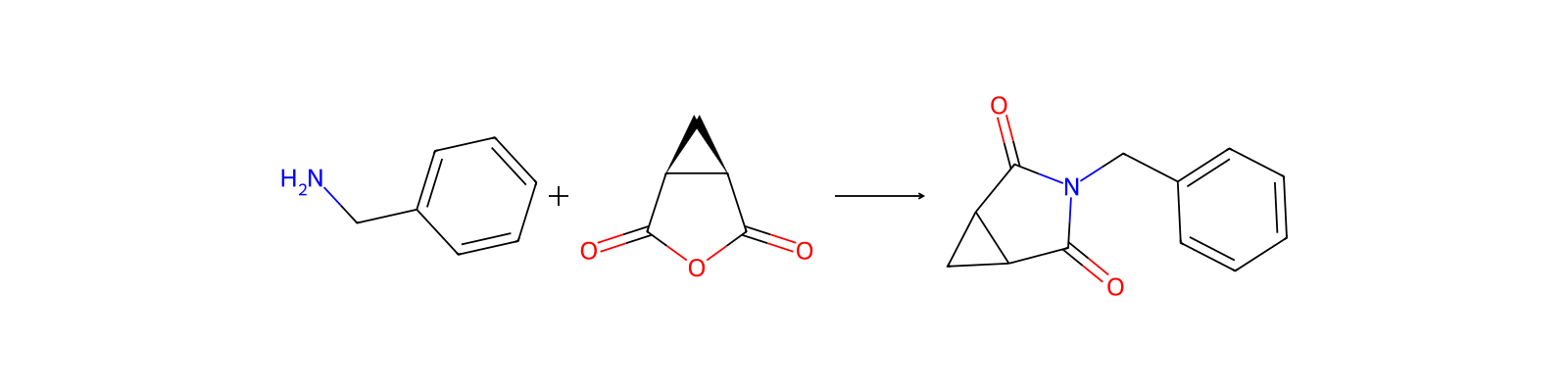
[CH2:1]([NH2:8])[C:2]1[CH:7]=[CH:6][CH:5]=[CH:4][CH:3]=1.[C@@H:9]12[C:15](=O)[O:14][C:12](=[O:13])[C@@H:10]1[CH2:11]2>>[CH2:1]([N:8]1[C:12](=[O:13])[CH:10]2[CH:9]([CH2:11]2)[C:15]1=[O:14])[C:2]1[CH:7]=[CH:6][CH:5]=[CH:4][CH:3]=1Participants



Conditions
- Temperature
- 180 °C
Procedure
63.2 g (0.486 mol) of 1 was added in portions to 150 ml of thionyl chloride. The mixture was refluxed for 1 hour, then was stripped. The residue was distilled to give cis-1,2-cyclopropanedicarboxylic acid anhydride (3A) bp 134° C. (10 Torr.). 2.14 g (0.02 mol) of benzylamine was carefully added to 2.24 g (0.02 mol) of 3A (CAUTION: THE REACTION IS VERY EXOTHERMIC.) The mixture was heated at 180° C. for 2 hours. After cooling, the residue was recrystallized from isopropyl alcohol to give 3-(benzyl)-3-azabicyclo(3.1.0)hexane-2,4-dione, as white needles, mp 90°-91° C. (3B). A cooled (0°) solution of 305 ml (1.09 mol) of 70% sodium bis(2-methoxyethoxy)aluminum hydride in benzene diluted with 600 ml of ether was treated with 48.7 g (0.24 mole) of 3B. The mixture was stirred at 0° for 1/2 hr and refluxed for 3 hrs. After standing at room temperature overnight, excess metal hydride was destroyed by cautiously adding cold water. The mixture was filtered after addition of diatomaceous silica (Celite). The ether layer was removed and the aqueous layer was extracted with ether. The combined organic layers were dried (MgSO4). Ether and 2-methoxyethanol were evaporated under reduced pressure to give 3, as an oil. Distillation gave 3, bp: 79°-80° C. (0.01 Torr.).
Workup
- temperatureAfter cooling
- customthe residue was recrystallized from isopropyl alcohol
Sources & evidence
- ORD record
- ord-a4bcf7a5252d4d338dc04ab0611f8b47
- Source dataset
- uspto-grants-1980_01
- Patent number
- US04183857
Reaction notes
Loading…