Participants
| Role | Name | HCID | Charge |
|---|
| Reactant | Ammonia | HCID 222 | — |
| Reactant | Urea | HCID 1176 | — |
| Reactant | N-Cyclohexyl-1,3-propanediamine | HCID 18718 | — |
| Solvent | Water | HCID 962 | — |
| Product | HCID 20528877 | HCID 20528877 | — |
Reaction Steps
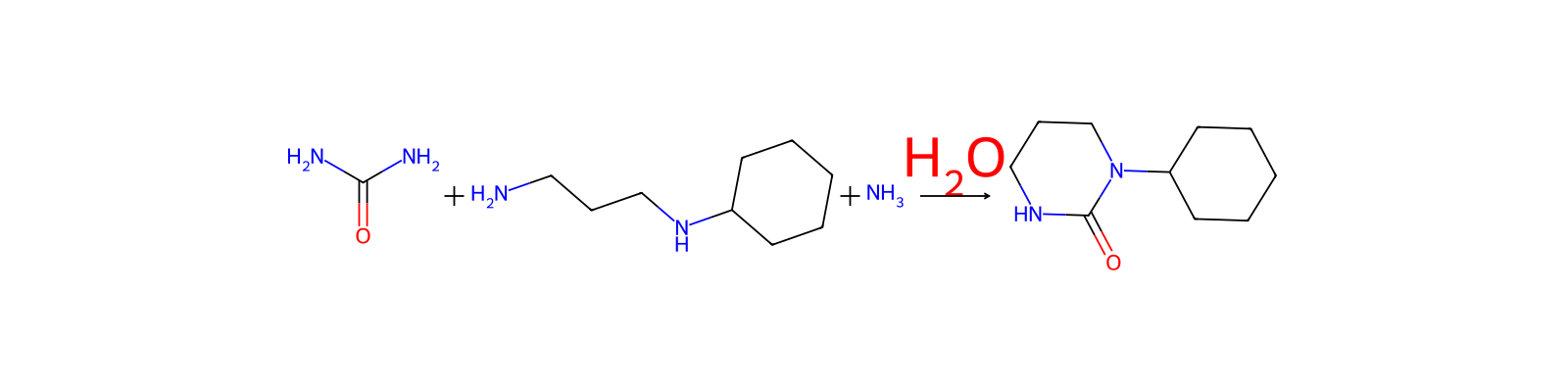
The reaction apparatus is a 500 ml flask, equipped with thermometer, reflux condenser and magnetic stirrer. The top of the reflux condenser is connected to a bubbler containing water. Before adding the reagents, the flask is weighed. Then 30 g of urea (0.5 mols) and 156 g of N-cyclohexyl-1,3-propanediamine (1 mol) are put into the flask, which is then slowly heated. Ammonia begins to evolve. Heating is continued until 18 g of ammonia have evolved. The reaction mixture is allowed to cool to room temperature. The solid which precipitates is separated by filtration on a Buchner funnel and dried in vacuo. The weight is 78 g and the melting point is 175° C. The raw reaction product is recrystallized from boiling ethanol. The melting point of the recrystallized product is 198° C. The nitrogen content is 15.25%, whereas the theoretical value is 15.37%. The structure of the product as confirmed by a combination of elemental analysis, 13C NMR and 1H NMR is determined as follows: ##STR3## The structure of this compound has been corroborated by IR and VPO molecular weight measurements. The elemental analysis is as follows:
Provenance & Evidence
| DOI | 10.6084/m9.figshare.5104873.v1 |
|---|
| Patent number | US04183903 |
|---|
| Source dataset | uspto-grants-1980_01 |
|---|
| ORD ID | ord-d6ba335345ca492d93c6e1085b03eea2 |
|---|
| Source note | uspto-grants-1980_01 |
|---|