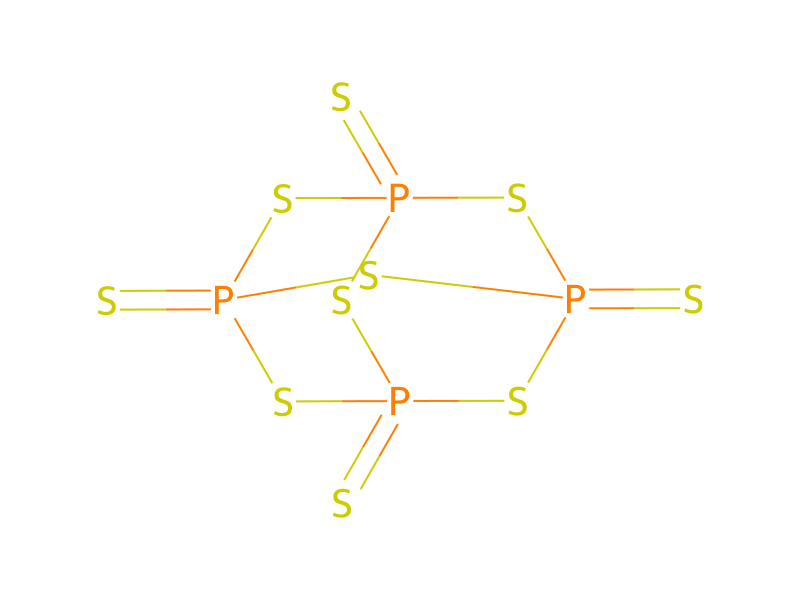
Phosphorus sulfide (P2S5) → HCID 69224180, compound
Reaction equation

[Cl:1][C:2]1[CH:7]=[CH:6][CH:5]=[C:4]([Cl:8])[C:3]=1[C:9]1[CH2:13][CH:12]([C:14]2[CH:19]=[CH:18][C:17]([N+:20]([O-:22])=[O:21])=[CH:16][CH:15]=2)O[N:10]=1.P12(SP3(SP(SP(S3)(S1)=S)(=S)S2)=S)=[S:24]>>[Cl:1][C:2]1[CH:7]=[CH:6][CH:5]=[C:4]([Cl:8])[C:3]=1[C:9]1[CH2:13][CH:12]([C:14]2[CH:19]=[CH:18][C:17]([N+:20]([O-:22])=[O:21])=[CH:16][CH:15]=2)[S:24][N:10]=1Participants
3


Procedure
By the method of Asian. J. Chem., 2000, 12, 1358-1360, (±)3-(2,6-dichlorophenyl)-5-(4-nitrophenyl)-2-isoxazoline can be treated with diphosphorus pentasulfide followed by aqueous quench to produce (±)-3-(2,6-dichlorophenyl)-5-(4-nitrophenyl)-2-isothiazoline. The nitrophenyl group can be reduced to the corresponding aniline with tin dichloride or iron powder and ammonium chloride. The aniline, in turn, can be treated with 2,2-dichloroacetyl chloride and triethylamine to yield (±)-2,2-dichloro-N-[4-[3-(2,6-dichlorophenyl)-5-(2-isothiazolinyl)]phenyl acetamide.
Workup
- customby aqueous quench
Sources & evidence
- ORD record
- ord-0b433499e2634f32b6e9b273721abc02
- Source dataset
- uspto-grants-2008_02
- Patent number
- US07326790B2
Reaction notes
Loading…