Lauric Acid → Silver laurate
Reaction equation

[OH-].[Na+].[C:3]([OH:16])(=[O:15])[CH2:4][CH2:5][CH2:6][CH2:7][CH2:8][CH2:9][CH2:10][CH2:11][CH2:12][CH2:13][CH3:14].[N+]([O-])([O-])=O.[Ag+:21]>C1(C)C=CC=CC=1.O>[C:3]([O-:16])(=[O:15])[CH2:4][CH2:5][CH2:6][CH2:7][CH2:8][CH2:9][CH2:10][CH2:11][CH2:12][CH2:13][CH3:14].[Ag+:21]Participants
Reactant 3
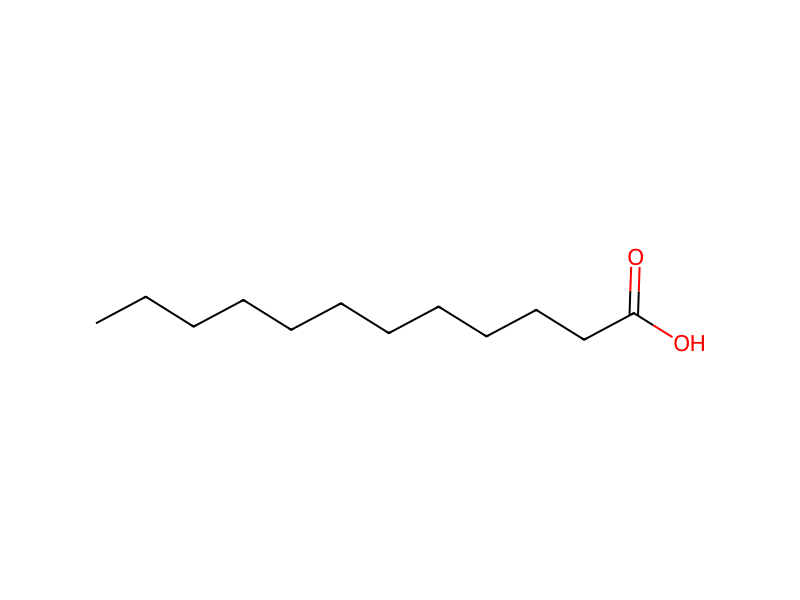


Product 1

Reagents, catalysts & solvents 2


Procedure
Into 100 ml of water was dissolved 1.9 g of sodium hydroxide, and the resulting solution was emulsified at 25° C. into a solution of 12 g of lauric acid in 100 ml of toluene. To this was added a solution of 8.5 g of silver nitrate in 50 ml of water. Upon being allowed to stand for 5 minutes, the mixture separated into water layer and a toluene layer containing silver laurate. The water layer was removed and 200 ml of ethanol was added to the toluene layer to disperse the silver laurate. The silver laurate was collected by centrifugation. 12 g of spindle shaped crystals having a major diameter of about 3 microns were obtained. (Silver laurate could be obtained in an almost equal manner using benzene, pentane, cyclohexane, butyl acetate, isoamyl acetate, butyl alcohol, tricresyl phosphate, dibutylphthalate, etc., in place of toluene in the above preparation.)
Workup
- customthe mixture separated into water layer
- additiona toluene layer containing silver laurate
- customThe water layer was removed
- addition200 ml of ethanol was added to the toluene layer
- additionto disperse the silver laurate
- customThe silver laurate was collected by centrifugation
- customwere obtained
Sources & evidence
- ORD record
- ord-2770e1cb58c64f9aa3f021157938a2f5
- Source dataset
- uspto-grants-1980_07
- Patent number
- US04211839
Reaction notes
Loading…