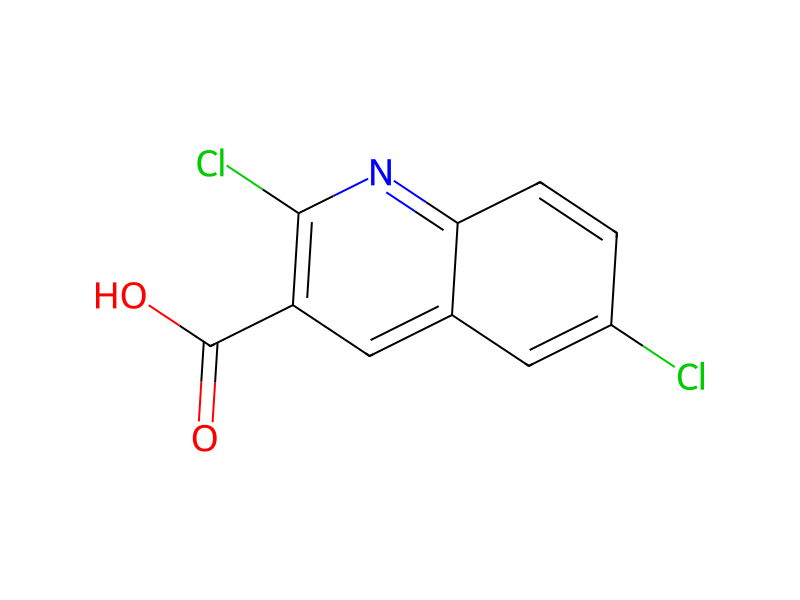
2,6-Dichloroquinoline-3-carboxylic acid → HCID 67359762, compound
Reaction equation

Cl[C:2]1[C:11]([C:12]([OH:14])=[O:13])=[CH:10][C:9]2[C:4](=[CH:5][CH:6]=[C:7]([Cl:15])[CH:8]=2)[N:3]=1.[NH2:16][CH:17]([CH:21]([C:25]1[CH:30]=[CH:29][CH:28]=[C:27]([F:31])[CH:26]=1)[C:22]([OH:24])=[O:23])[C:18]([OH:20])=[O:19]>CS(C)=O>[C:12]([C:11]1[C:2]([NH:16][CH:17]([CH:21]([C:25]2[CH:30]=[CH:29][CH:28]=[C:27]([F:31])[CH:26]=2)[C:22]([OH:24])=[O:23])[C:18]([OH:20])=[O:19])=[N:3][C:4]2[C:9]([CH:10]=1)=[CH:8][C:7]([Cl:15])=[CH:6][CH:5]=2)([OH:14])=[O:13]Participants
4
Reactant 2

Product 1

Reagents, catalysts & solvents 1

Procedure
In close analogy to the procedure described in Example 1, 2,6-dichloroquinoline-3-carboxylic acid is reacted with 2-amino-3-(3-fluoro-phenyl)-succinic acid [prepared by analogy to J. Med. Chem. 1973, 16, 1277-1280.; using alkylation of diethyl acetamidomalonate by methyl bromo-(3-fluoro-phenyl)-acetate] in DMSO to provide the title compound in good yield.
Sources & evidence
- ORD record
- ord-daea4b92388e493ab25218b74d3ccd56
- Source dataset
- uspto-grants-2012_10
- Patent number
- US08288549B2
Reaction notes
Loading…