3-Hydroxybenzoic Acid → HCID 21413335, compound
Reaction equation

[OH-].[Na+].Cl.[Cl:4][C:5]1[CH:10]=[C:9]([Cl:11])[C:8]([OH:12])=[C:7]([NH2:13])[CH:6]=1.B(O)(O)O.[OH:18][C:19]1[CH:20]=[C:21]([CH:25]=[CH:26][CH:27]=1)[C:22](O)=O>C1C=C(Cl)C(Cl)=CC=1>[OH:18][C:19]1[CH:20]=[C:21]([C:22]2[O:12][C:8]3[C:9]([Cl:11])=[CH:10][C:5]([Cl:4])=[CH:6][C:7]=3[N:13]=2)[CH:25]=[CH:26][CH:27]=1Participants
Reactant 4

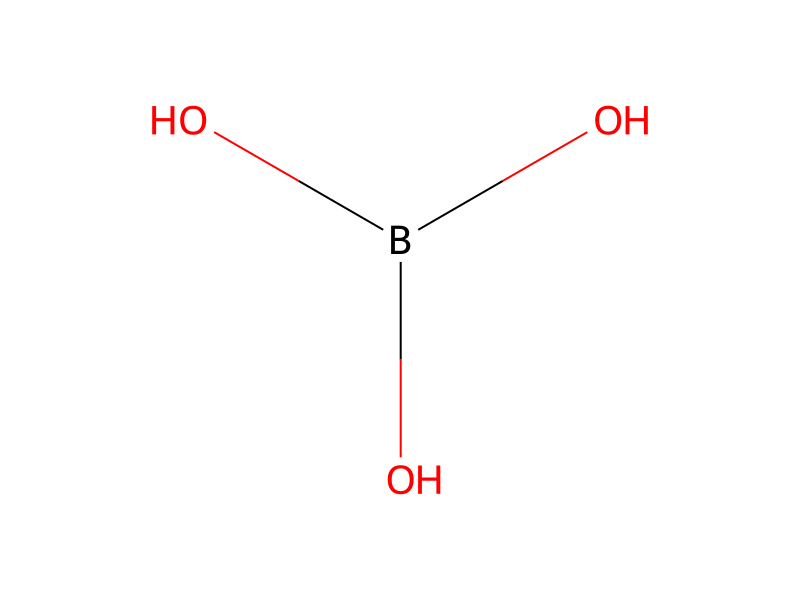


Product 1

Reagents, catalysts & solvents 1

Procedure
178 parts of 45% strength sodium hydroxide solution are added dropwise to a suspension of 460 parts of 93% strength 4,6-dichloro-2-aminophenol hydrochloride in 1,500 parts by volume of dichlorobenzene mixture at 110° to 120°, under a nitrogen atmosphere, 30 parts of boric acid and 276 parts of 3-hydroxy-benzoic acid are added to the resulting clear solution and the water is removed from the system by means of a water separator (about 10 hours). The hot reaction solution is then poured into about 2,500 parts by volume of n-butanol, the hot solution is clarified with fuller's earth and after cooling and, if necessary, further concentrating, about 280 to 290 parts of 2-(3'-hydroxyphenyl) 5,7-dichlorobenzoxazole are obtained, which can be purified further by recrystallisation from chlorobenzene (melting point 233° to 234°). Molecular weight, calculated and confirmed by mass spectrometry at m/e = 280.
Workup
- customthe water is removed from the system by means of a water separator (about 10 hours)
- additionThe hot reaction solution is then poured into about 2,500 parts by volume of n-butanol
- temperatureafter cooling
Sources & evidence
- ORD record
- ord-d1c16a57a19c4881ac10ecf1fc2db8b2
- Source dataset
- uspto-grants-1977_09
- Patent number
- US04046771
Reaction notes
Loading…