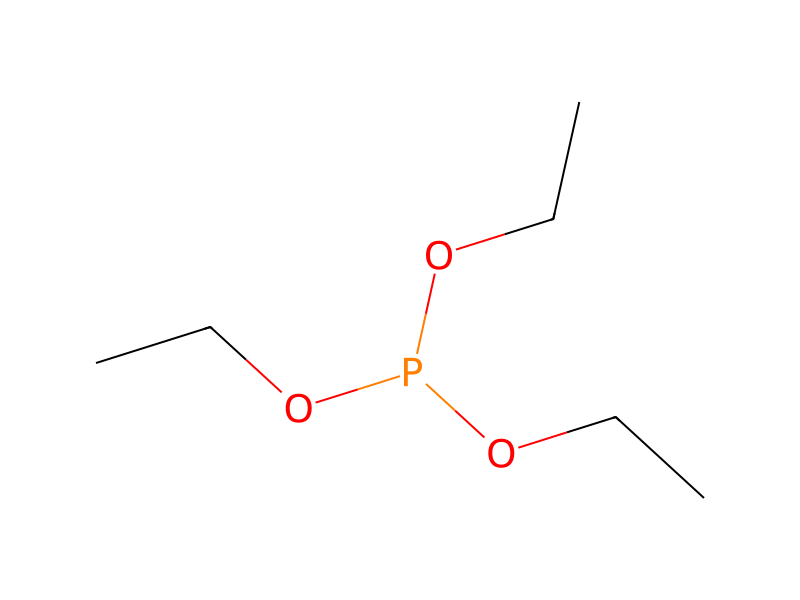
Triethyl phosphite → Phosphonic acid, [[4-(bromomethyl)phenyl]methyl]-, diethyl ester
Reaction equation

Br[CH2:2][C:3]1[CH:8]=[CH:7][C:6]([CH2:9][Br:10])=[CH:5][CH:4]=1.[CH2:11]([O:13][P:14]([O:18]CC)[O:15][CH2:16][CH3:17])[CH3:12]>C1(C)C=CC=CC=1>[Br:10][CH2:9][C:6]1[CH:7]=[CH:8][C:3]([CH2:2][P:14]([O:15][CH2:16][CH3:17])([O:13][CH2:11][CH3:12])=[O:18])=[CH:4][CH:5]=1Participants
Reactant 2

Product 1

Reagents, catalysts & solvents 1

Procedure
α,α'-Dibromo-p-xylene (22.9 gm) was combined with toluene (70 mL) and heated to reflux. Once the dibromide had completely dissolved, triethylphosphite (5.9 mL) was added all at once and heating continued for 6 hours. The reaction mixture was allowed to cool to room temperature and the excess solid dibromide was removed by suction filtration and washed with a small amount of methylene chloride. The organic solutions were combined and concentrated, on a rotatory evaporator, to a white solid. The solid was taken up in methylene chloride (50 mL) and chromatographed on silica (350 gm). The column was eluted with methylene chloride and fractions of about 25 mL were collected The first peak eluted in fractions 14-24 (excess dibromide), then the solvent was changed to 5% ethanol/methylene chloride. The second major peak, fractions 37-53, was the desired product obtained as a pale yellow oil.
Workup
- temperatureheated to reflux
- temperatureheating
- customthe excess solid dibromide was removed by suction filtration
- washwashed with a small amount of methylene chloride
- concentrationconcentrated, on a rotatory evaporator, to a white solid
- customchromatographed on silica (350 gm)
- washThe column was eluted with methylene chloride and fractions of about 25 mL
- customwere collected The first peak
- washeluted in fractions 14-24 (excess dibromide)
- customobtained as a pale yellow oil
Sources & evidence
- ORD record
- ord-cdf4cbe6221d46ef855b96c5a27289bf
- Source dataset
- uspto-grants-1990_04
- Patent number
- US04918064
Reaction notes
Loading…