HuagongsheHuagongshe Chemistry Print Report · For research reference only
HRID 2075673Generated: October 29, 2026
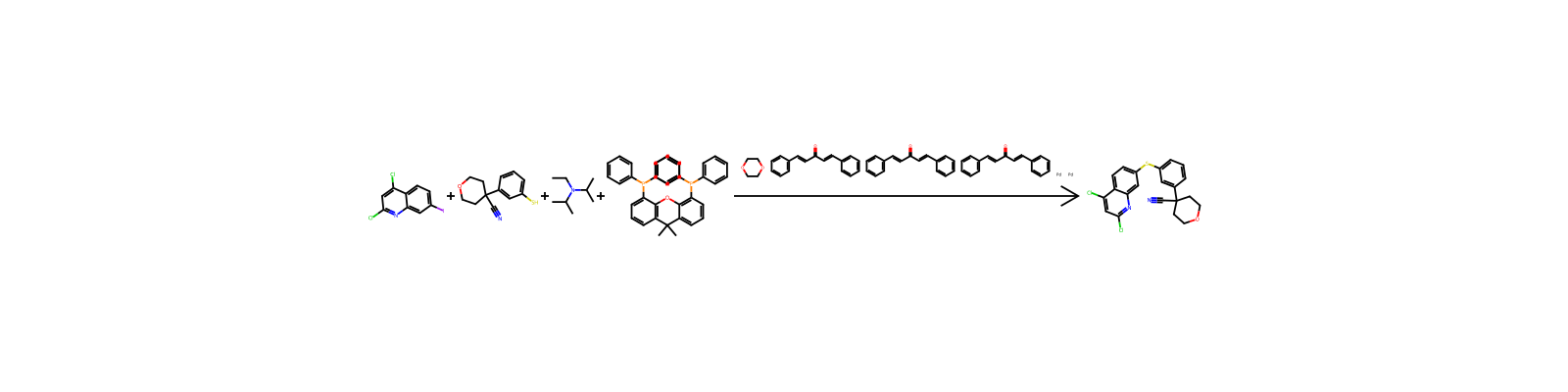
Diisopropylethylamine → 4-[3-(2,4-Dichloro-quinolin-7-ylsulfanyl)-phenyl]-tetrahydro-pyran-4-carbonitrile
https://huagongshe.com/reaction/2075673
Participants
| Role | Name | HCID | Charge |
|---|
| Reactant | Diisopropylethylamine | HCID 81531 | — |
| Reactant | 1,1'-(9,9-Dimethyl-9H-xanthene-4,5-diyl)bis(1,1-diphenylphosphine) | HCID 636044 | — |
| Reactant | 4-(3-Mercapto-phenyl)-tetrahydro-pyran-4-carbonitrile | HCID 18786386 | — |
| Reactant | 2,4-Dichloro-7-iodo-quinoline | HCID 86613821 | — |
| Catalyst | Bis(dibenzylideneacetone)palladium | HCID 9811564 | — |
| Solvent | 1,4-Dioxane | HCID 31275 | — |
| Product | 4-[3-(2,4-Dichloro-quinolin-7-ylsulfanyl)-phenyl]-tetrahydro-pyran-4-carbonitrile | HCID 86613825 | — |
Reaction Steps
2,4-Dichloro-7-iodo-quinoline (3.4 g, 10.5 mmol), 4-(3-mercapto-phenyl)-tetrahydro-pyran-4-carbonitrile (3a, 2.3 g, 10.5 mmol), iPr2NEt (3.67 mL, 21.0 mmol), Pd2dba3 (240 mg, 0.26 mmol), and 4,5-bis(diphenylphosphino)-9,9-dimethylxanthene (303 mg, 0.52 mmol) were dissolved in 1,4-dioxane (50 mL) and degassed for 10 minutes with N2. The reaction was then sealed and heated to 60° C. for 1 hour. After cooling to room temperature, the reaction was diluted with EtOAc and saturated aqueous NH4Cl. The aqueous layer was extracted with EtOAc, and the combined organic layers were dried over MgSO4, filtered, and concentration. The residue was purified by silica gel chromatography (30% EtOAc in hexanes) to give the desired product, 3b.
Provenance & Evidence
| DOI | 10.6084/m9.figshare.5104873.v1 |
|---|
| Patent number | US07919621B2 |
|---|
| Source dataset | uspto-grants-2011_04 |
|---|
| ORD ID | ord-f7cf6a8aff294b7da929f79cd5125135 |
|---|
| Source note | uspto-grants-2011_04 |
|---|