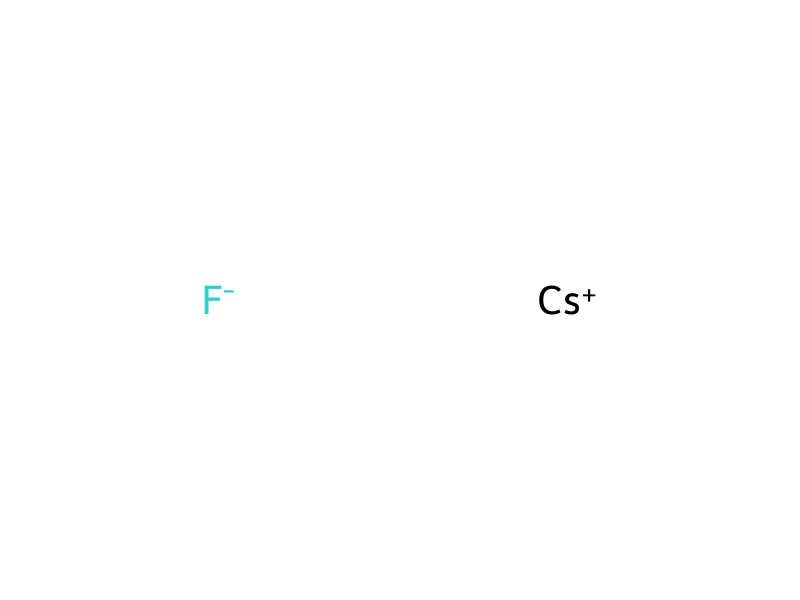
Cesium fluoride → 2-Pyrazinecarbonitrile,4-[(1S)-1-cyclopropyl-2-methoxyethyl]-6-[[6-(difluoromethoxy)-2,5-dimethyl-3-pyridinyl]amino]-4,5-dihydro-5-oxo-
Reaction equation

[CH:1]1([C@H:4]([N:8]2[C:13](=[O:14])[C:12]([NH:15][C:16]3[C:17]([CH3:24])=[N:18][C:19]([OH:23])=[C:20]([CH3:22])[CH:21]=3)=[N:11][C:10]([C:25]#[N:26])=[CH:9]2)[CH2:5][O:6][CH3:7])[CH2:3][CH2:2]1.[F-].[Cs+].[F:29][C:30]([F:42])(S(F)(=O)=O)C(O[Si](C)(C)C)=O>C(#N)C>[CH:1]1([C@H:4]([N:8]2[C:13](=[O:14])[C:12]([NH:15][C:16]3[C:17]([CH3:24])=[N:18][C:19]([O:23][CH:30]([F:42])[F:29])=[C:20]([CH3:22])[CH:21]=3)=[N:11][C:10]([C:25]#[N:26])=[CH:9]2)[CH2:5][O:6][CH3:7])[CH2:3][CH2:2]1Participants
Reactant 3


Product 1

Reagents, catalysts & solvents 1

Procedure
A mixture of pure (S)-4-(1-cyclopropyl-2-methoxyethyl)-6-(6-hydroxy-2,5-dimethylpyridin-3-ylamino)-5-oxo-4,5-dihydropyrazine-2-carbonitrile (2.3 g, 6.5 mmol) and CsF (395 mg, 2.6 mmol) was added to acetonitrile (65 mL). To the resulting suspension, trimethylsilyl 2,2-difluoro-2-(fluorosulfonyl)acetate (3.82 mL, 19.4 mmol) was slowly added (use extreme caution! The reagent can cause dermatological damage and should always be handled in hood). LC-MS analysis after 1 h showed the reaction to be complete (89% conversion to required product), Volatiles were evaporated in vacuo and the residue was partitioned between EtOAc (3×120 mL) and H2O (˜100 mL). The organic layer was washed with water (2×50 mL) and brine (50 mL), and dried over Na2SO4. The ethyl acetate was evaporated in vacuo and the residue was dissolved in DMF (10 mL). The solution was applied to C18 silica gel column (14 cm×5 cm) equilibrated with MeCN:H2O (1:2). The column was eluted with 33% MeCN/H2O (500 mL), 45% MeCN/H2O (500 mL), 60% MeCN/H2O (1000 mL), 70% MeCN/H2O (500 mL). Individual fractions were analyzed by LC-MS (product comes out in between 60%-70% MeCN/H2O). Fractions containing pure product were combined and concentrated in vacuo to give pure (S)-4-(1-cyclopropyl-2-methoxyethyl)-6-(6-(difluoromethoxy)-2,5-dimethylpyridin-3-ylamino)-5-oxo-4,5-dihydropyrazine-2-carbonitrile (2.28 g, 87% yield) as pale yellow solid: 1H NMR (CDCl3) δ 8.43 (s, 1H); 8.01 (s, 1H); 7.56 (s, 1H); 7.49 (t, JH-F=73.8 Hz, 1H); 4.15-4.18 (m, 1H); 3.76 (dd, JAB=10.4, JAX=5.2 Hz, 1H); 3.68 (dd, JBA=10.4, JBX=3.1 Hz, 1H); 3.37 (s, 3H); 2.46 (s, 3H); 2.30 (s, 3H); 1.35-1.42 (m, 1H); 0.82-0.88 (m, 1H); 0.64-0.69 (m, 1H); 0.53-0.58 (m, 1H); 0.31-0.36 (m, 1H); 13C NMR (126 MHz, CDCl3) δ 153.0, 151.5, 147.8, 143.8, 133.3, 129.4, 125.6, 119.1, 117.2, 114.8 (t, J=256.1 Hz, 1C), 107.6, 72.7, 62.6, 59.6, 20.0, 15.5, 11.4, 6.4, 4.2; 19F NMR (CDCl3) δ-88.73 (d); LRMS (ESI) m/e 406 [(M+H)+, calcd for C19H22N5O3F2 406]; tR=2.7 min (Solvent A: MeOH:H2O:TFA=10:90:0.1; Solvent B: MeOH:H2O:TFA=90:10:0.1; 40% B in A to 100% B in A linear gradient in a 3 min run with 1 min hold time at the end, λ=280 nm).
Workup
- customthe reaction
Sources & evidence
- ORD record
- ord-09ce56ba4e964b2ebb700dbfab1b0a3d
- Source dataset
- uspto-grants-2011_04
- Patent number
- US07932256B2
Reaction notes
Loading…