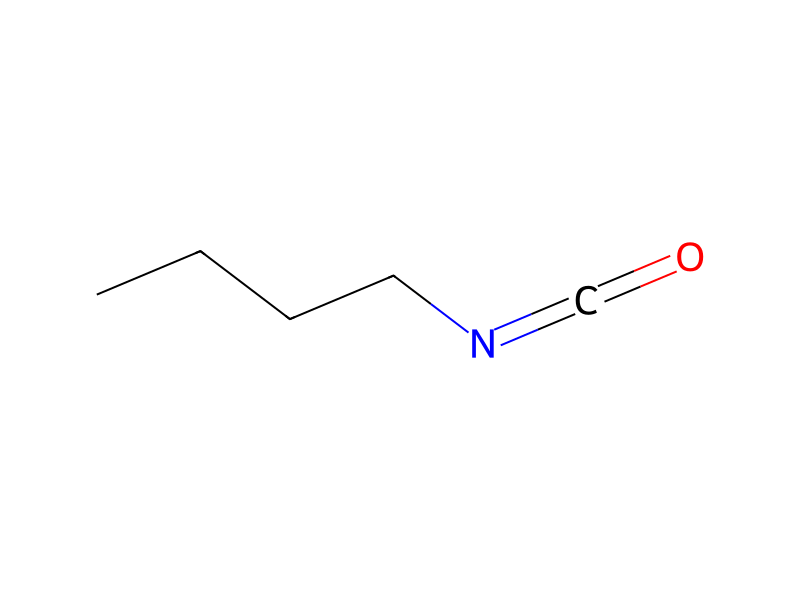
Butyl isocyanate → 5-n-butylaminocarbonyloxy-6-(7-chloro-1,8-naphthyridin-2-yl)-7-oxo-6,7-dihydro-5H-pyrrolo[3,4-b]pyridine
Reaction equation

[Cl:1][C:2]1[N:11]=[C:10]2[C:5]([CH:6]=[CH:7][C:8]([N:12]3[CH:20]([OH:21])[C:19]4[C:14](=[N:15][CH:16]=[CH:17][CH:18]=4)[C:13]3=[O:22])=[N:9]2)=[CH:4][CH:3]=1.[CH2:23]([N:27]=[C:28]=[O:29])[CH2:24][CH2:25][CH3:26].C(N(CC)CC)C>C(#N)C.C(N(CC)CC)C>[CH2:23]([NH:27][C:28]([O:21][CH:20]1[C:19]2[C:14](=[N:15][CH:16]=[CH:17][CH:18]=2)[C:13](=[O:22])[N:12]1[C:8]1[CH:7]=[CH:6][C:5]2[C:10](=[N:11][C:2]([Cl:1])=[CH:3][CH:4]=2)[N:9]=1)=[O:29])[CH2:24][CH2:25][CH3:26]Participants
Reactant 3


Product 1

Reagents, catalysts & solvents 2

Procedure
A suspension of 6-(7-chloro-1,8-naphthyridin-2-yl)-5-hydroxy-7-oxo-6,7-dihydro-5H-pyrrolo[3,4-b]pyridine (1 g.) in acetonitrile (100 cc.) containing n-butyl isocyanate (7.25 cc.) and triethylamine (0.5 cc.) is heated at the reflux temperature for 3 hours. n-Butyl isocyanate (2.9 cc.) and triethylamine (2 drops) are then added and heating at the reflux temperature is continued for a further 30 minutes. After concentrating the mixture to dryness under reduced pressure (40 mm.Hg), the residue is triturated with diisopropyl ether (10 cc.). The precipitate is filtered off and recrystallised from acetonitrile (41 cc.) to give 5-n-butylaminocarbonyloxy-6-(7-chloro-1,8-naphthyridin-2-yl)-7-oxo-6,7-dihydro-5H-pyrrolo[3,4-b]pyridine (0.8 g.) melting at 215° C.
Workup
- temperatureis heated at the reflux temperature for 3 hours
- temperatureheating at the reflux temperature
- concentrationAfter concentrating the mixture to dryness under reduced pressure (40 mm.Hg)
- customthe residue is triturated with diisopropyl ether (10 cc.)
- filtrationThe precipitate is filtered off
- customrecrystallised from acetonitrile (41 cc.)
Sources & evidence
- ORD record
- ord-fd9a07dcda694b72a1af5d1a2a9fc114
- Source dataset
- uspto-grants-1978_04
- Patent number
- US04086348
Reaction notes
Loading…