Hexane → HCID 12135718, compound
Reaction equation

CCCCCC.Br[C:8]1[CH:13]=[CH:12][C:11]([O:14][CH3:15])=[CH:10][C:9]=1[O:16][CH3:17].C([Li])CCC.[CH2:23]([Si:26](OC)([O:29][CH3:30])[O:27][CH3:28])[CH2:24][CH3:25]>C(O)C>[CH3:17][O:16][C:9]1[CH:10]=[C:11]([O:14][CH3:15])[CH:12]=[CH:13][C:8]=1[Si:26]([CH2:23][CH2:24][CH3:25])([O:29][CH3:30])[O:27][CH3:28]Participants
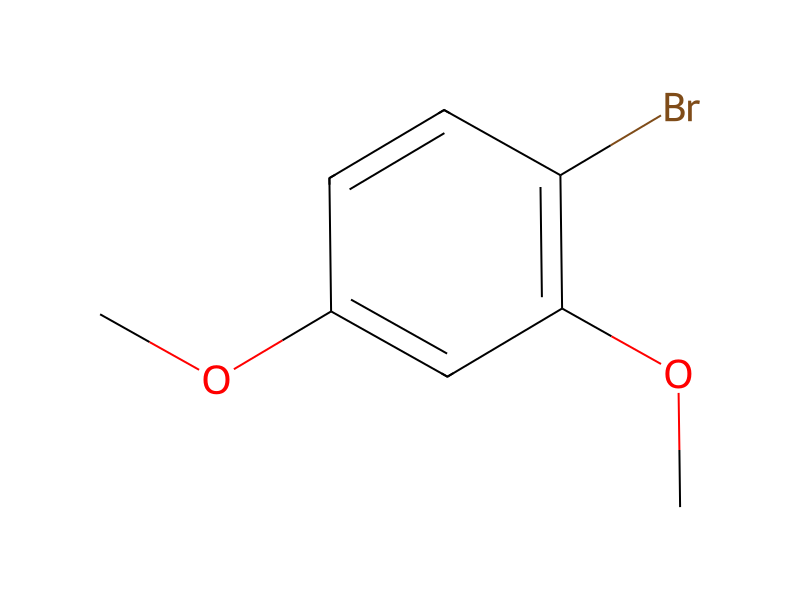
Reactant 4



Product 1

Reagents, catalysts & solvents 1

Conditions
- Temperature
- 0 °C
Procedure
A 500 mL round bottomed flask was charged with hexane (200 mL, Aldrich) and bromo-2,4-dimethoxybenzene (12.2 g, 56.0 mmol, Aldrich). The contents were cooled to 0° C. and n-butyl lithium (34.7 mL of a 1.6M solution in hexanes, 55.5 mmol, Aldrich) was added over 15 minutes (white precipitate). The contents were stirred at room temperature for ninety (90) minutes. The solution was added, via cannula, into a 1000 mL round bottomed flask containing hexane (300 mL, Aldrich) and propyl-trimethoxysilane (9.8 mL, 56 mmol). The reaction was stirred at room temperature overnight (18 hours). Ethanol (10 mL, Aldrich) was added to quench residual base. The contents were poured into 0.2N HCl (250 mL). The layers were separated and the product extracted into ether (2×150 mL). The combined organic portions were dried (MgSO4), filtered, and the solvent removed via rotary evaporation (16.2 g crude). Distillation under reduced pressure (b.p. 115° C., 0.04 mm Hg) provided 2,4-dimethoxyphenyl-propyl-dimethoxysilane (9.13 g, 33.8 mmol, 61% yield); C13H22O4Si (Mw=270.40); 1H NMR (CDCl3) δ7.5 (d, 1H), 6.5 (m, 1H), 6.4 (d, 1H), 3.8 (s, 3H), 3.8 (s, 3H), 3.5 (s,6H), 1.4 (m, 2H), 0.9 (t, 3H), 0.8 (t, 2H); 13C NMR (CDCI3) δ165.8, 163.2, 137.6, 112.7, 104.6, 97.5, 55.0, 54.9, 50.4, 17.7, 16.2, 15.4; IR (capillary film) ν2950, 2836, 1596, 1571, 1460, 1299, 1206, 1154, 1089, 1036; MS m/z (relative abundance) 270 (11.1), 227 (45.6), 197 (100), 167 (24.4), 137 (10.9), 121 (22.6), 91 (9.9), 59 (18.4).
Workup
- additionThe solution was added, via cannula, into a 1000 mL round bottomed flask
- customto quench residual base
- additionThe contents were poured into 0.2N HCl (250 mL)
- customThe layers were separated
- extractionthe product extracted into ether (2×150 mL)
- dry with materialThe combined organic portions were dried (MgSO4)
- filtrationfiltered
- customthe solvent removed via rotary evaporation (16.2 g crude)
- distillationDistillation under reduced pressure (b.p. 115° C., 0.04 mm Hg)
Sources & evidence
- ORD record
- ord-2f27fc6866134c8f86e5d292d3c2853e
- Source dataset
- uspto-grants-2004_04
- Patent number
- US06723865B2
Reaction notes
Loading…