Chloroacetyl chloride → 2-[(2-Chloroacetyl)amino]-6-methylbenzoic acid
Reaction equation

NC1N=CN=C2C=1N=CN2CC1N(C2C=CC=CC=2C)C(=O)C2C(=CC=CC=2C)N=1.[NH2:31][C:32]1[CH:40]=[CH:39][CH:38]=[C:37]([CH3:41])[C:33]=1[C:34]([OH:36])=[O:35].[Cl:42][CH2:43][C:44](Cl)=[O:45]>>[Cl:42][CH2:43][C:44]([NH:31][C:32]1[CH:40]=[CH:39][CH:38]=[C:37]([CH3:41])[C:33]=1[C:34]([OH:36])=[O:35])=[O:45]Participants
4

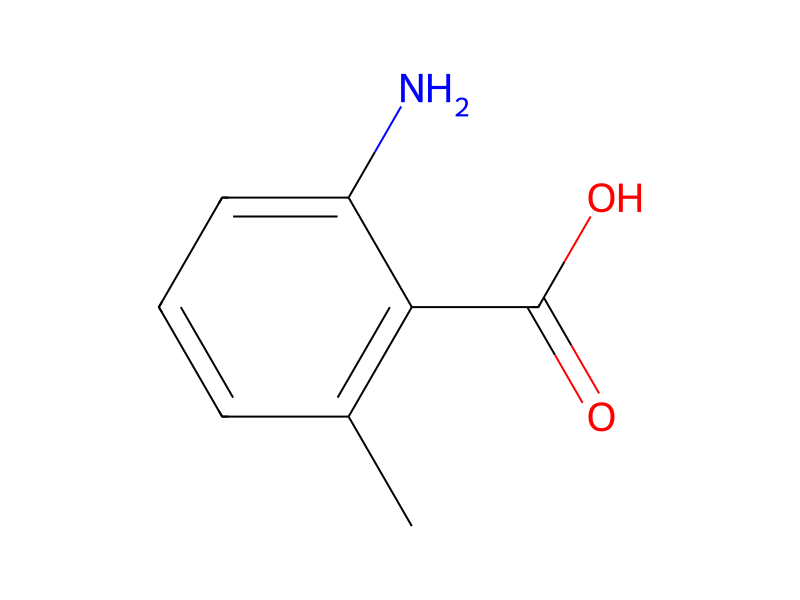


Procedure
The synthetic scheme for the preparation of 2-((6-amino-9H-purin-9-yl)methyl)-5-methyl-3-o-tolylquinazolin-4(3H)-one, 1, is shown in FIG. 1. 2-amino-6-methylbenzoic acid, 1″, is reacted with 2-chloroacetyl chloride to produce the 2-(−2-chloroacetamido)-6-methylbenzoic acid, 2″. Reaction with o-toluidine and phosphoryl trichloride yields the cyclized intermediate, 3″. Further reaction with diBOC-protected adenine give the BOC protected product, 4″, which is deprotected resulting in 2-((6-amino-9H-purin-9-yl)methyl)-5-methyl-3-o-tolylquinazolin-4(3H)-one, 1.
Sources & evidence
- ORD record
- ord-d62016e2742449669f7c2c625a0e0eb1
- Source dataset
- uspto-grants-2013_05
- Patent number
- US08440677B2
Reaction notes
Loading…