Sodium Carbonate → methyl 2''-{[(4S,5R)-5-(3,5-dichlorophenyl)-4-methyl-2-oxo-1,3-oxazolidin-3-yl]methyl}-4'-methoxy-2-methyl-4''-(trifluoromethyl)-1,1':3',1''-terphenyl-4-carboxylate
Reaction equation

[Cl:1][C:2]1[CH:3]=[C:4]([C@H:9]2[O:13][C:12](=[O:14])[N:11]([CH2:15][C:16]3[CH:21]=[C:20]([C:22]([F:25])([F:24])[F:23])[CH:19]=[CH:18][C:17]=3I)[C@H:10]2[CH3:27])[CH:5]=[C:6]([Cl:8])[CH:7]=1.[CH3:28][O:29][C:30]1[CH:35]=[CH:34][C:33]([C:36]2[CH:41]=[CH:40][C:39]([C:42]([O:44][CH3:45])=[O:43])=[CH:38][C:37]=2[CH3:46])=[CH:32][C:31]=1B1OC(C)(C)C(C)(C)O1.C(=O)([O-])[O-].[Na+].[Na+]>ClCCl.[Pd](Cl)Cl.C1(P(C2C=CC=CC=2)[C-]2C=CC=C2)C=CC=CC=1.[C-]1(P(C2C=CC=CC=2)C2C=CC=CC=2)C=CC=C1.[Fe+2].O1CCOCC1>[Cl:1][C:2]1[CH:3]=[C:4]([C@H:9]2[O:13][C:12](=[O:14])[N:11]([CH2:15][C:16]3[CH:21]=[C:20]([C:22]([F:25])([F:24])[F:23])[CH:19]=[CH:18][C:17]=3[C:31]3[CH:32]=[C:33]([C:36]4[CH:41]=[CH:40][C:39]([C:42]([O:44][CH3:45])=[O:43])=[CH:38][C:37]=4[CH3:46])[CH:34]=[CH:35][C:30]=3[O:29][CH3:28])[C@H:10]2[CH3:27])[CH:5]=[C:6]([Cl:8])[CH:7]=1Participants
Reactant 3



Product 1

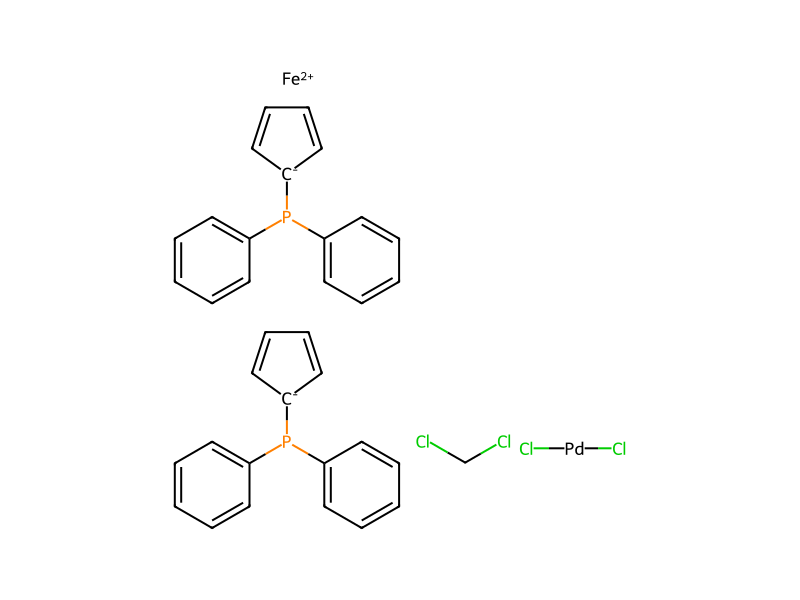
Reagents, catalysts & solvents 2

Procedure
((4S,5R)-5-(3,5-dichlorophenyl)-3-[2-iodo-5-(trifluoromethyl)benzyl]-4-methyl-1,3-oxazolidin-2-one (100 mg, 0.1886 mmol), methyl 4′-methoxy-2-methyl-3′-(4,4,5,5-tetramethyl-1,3,2-dioxaborolan-2-yl)biphenyl-4-carboxylate (108 mg, 0.283 mmol), 1,1′-bis(diphenylphosphino)ferrocene-palladium dichloride dichloromethane adduct (46 mg, 0.056 mmol), aqueous sodium carbonate (190 μL, 2M, 0.380 mmol) and 1,4-dioxane (2 mL) were placed in a sealed tube and subjected to microwave irradiation at 130° C. for 30 minutes and then at 135° C. for 15 minutes to complete the reaction. The crude reaction mixture was purified by preparative TLC on SiO2 (eluted sequentially with 30% ethyl acetate in hexanes, 70% dichloromethane in hexanes and then 80% dichloromethane in hexanes) to afford methyl 2″-{[(4S,5R)-5-(3,5-dichlorophenyl)-4-methyl-2-oxo-1,3-oxazolidin-3-yl]methyl}-4′-methoxy-2-methyl-4″-(trifluoromethyl)-1,1′:3′,1″-terphenyl-4-carboxylate as a white solid. LCMS calc.=657.13; found=658.46 (M+1)+. 1H NMR signals are doubled because of atropisomerism 1H NMR (CDCl3, 500 MHz) δ 7.94 (d, J=7 Hz, 1H), 7.87 (d, J=8.5 Hz, 1H), 7.70 (s, 0.5H), 7.65-7.61 (m, 1.5H), 7.47-7.36 (m, 3H), 7.32 (d, J=2 Hz, 0.5H), 7.29-7.23 (m, 1.5H), 7.11 (dd, J=6.3, 2.0 Hz, 1H), 7.08-7.02 (m, 1.5H), 7.00 (dd, J=8.3, 2.0 Hz, 0.5H), 5.41 (d, J=8.5 Hz, 0.5H), 5.16 (d, J=8.0 Hz, 0.5H), 4.91 (d, J=16 Hz, 0.5H), 4.85 (d, J=16.5 Hz, 0.5H), 4.17 (d, J=16 Hz, 0.5H), 3.98-3.90 (m, 3.5H), 3.856, 3.851 (s, 3H), 3.74-3.66 (m, 1H), 2.36, 2.32 (s, 3H), 0.55 (d, J=7 Hz, 1.5H), 0.43 (d, J=6 Hz, 1.5H).
Workup
- customirradiation at 130° C. for 30 minutes
- customthe reaction
- customThe crude reaction mixture
- customwas purified by preparative TLC on SiO2 (
- washeluted sequentially with 30% ethyl acetate in hexanes, 70% dichloromethane in hexanes
Sources & evidence
- ORD record
- ord-188dd18dc9974db995c94b5b68fd9265
- Source dataset
- uspto-grants-2013_05
- Patent number
- US08440702B2
Reaction notes
Loading…