3-Cyanophenylboronic acid → HCID 67174268, compound
Reaction equation

Br[C:2]1[CH:3]=[C:4]2[C:9](=[CH:10][CH:11]=1)[O:8][CH:7]([C:12]1[CH:17]=[CH:16][CH:15]=[CH:14][CH:13]=1)[CH2:6][C:5]2=[CH2:18].[C:19]([C:21]1[CH:22]=[C:23](B(O)O)[CH:24]=[CH:25][CH:26]=1)#[N:20]>O1CCOCC1.C([O-])([O-])=O.[Cs+].[Cs+].Cl[Pd](Cl)([P](C1C=CC=CC=1)(C1C=CC=CC=1)C1C=CC=CC=1)[P](C1C=CC=CC=1)(C1C=CC=CC=1)C1C=CC=CC=1>[CH2:18]=[C:5]1[C:4]2[C:9](=[CH:10][CH:11]=[C:2]([C:25]3[CH:26]=[C:21]([CH:22]=[CH:23][CH:24]=3)[C:19]#[N:20])[CH:3]=2)[O:8][CH:7]([C:12]2[CH:17]=[CH:16][CH:15]=[CH:14][CH:13]=2)[CH2:6]1Participants
6
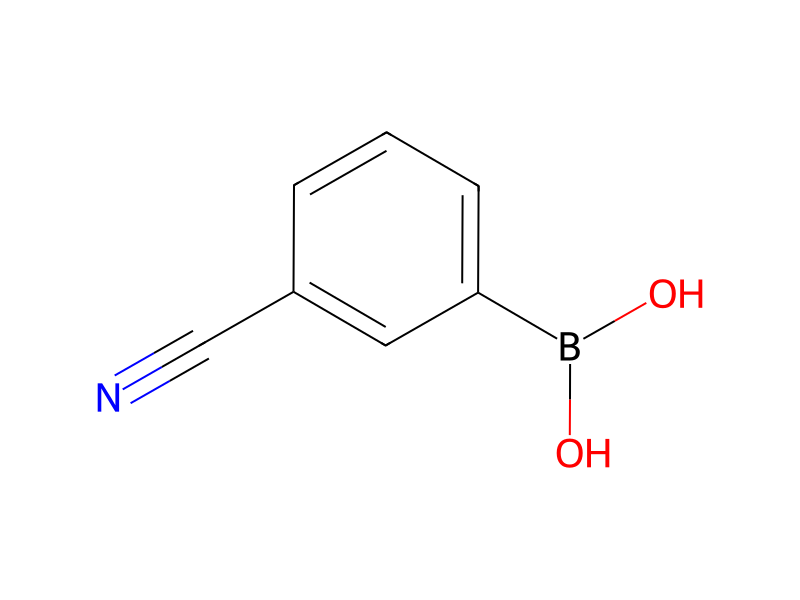





Conditions
- Temperature
- 120 °C
Procedure
Pd(PPh3)2Cl2 (40 mg) in a 100 mL of flask under Ar2 was treated sequentially with 6-bromo-4-methylene-2-phenylchroman (200 mg, 0.67 mmol) in [1,4]dioxane (20 mL), Cs2CO3 (2 N, 3.33 mL) and 3-cyanophenylboronic acid (167 mg, 1.13 mmol). The mixture was heated under 120° C. at Ar2 under microwave for 30 minutes. The reaction mixture was concentrated in vacuo to give the residue, which was purified preparative TLC to give 3-(4-methylene-2-phenyl-chroman-6-yl)-benzonitrile (110 mg, 51%). 1H-NMR (CDCl3): 2.81 (m, 2H), 4.96 (d, 1H), 5.10 (m, 1H), 5.61 (d, 1H), 7.98 (d, 1H), 7.29 (m, 1H), 7.35 (m, 3H), 7.41 (m, 2H), 7.46 (m, 1H), 7.52 (m, 1H), 7.72 (m, 2H), 7.79 (d, 1H).
Workup
- concentrationThe reaction mixture was concentrated in vacuo
- customto give the residue, which
- customwas purified preparative TLC
Sources & evidence
- ORD record
- ord-42db2221d5ba47c0bf0b7b4f5a98f78e
- Source dataset
- uspto-grants-2013_05
- Patent number
- US08450308B2
Reaction notes
Loading…