Sodium borohydride → (2-Chloro-4-morpholinothieno[3,2-d]pyrimidin-6-yl)methanol
Reaction equation

[Cl:1][C:2]1[N:3]=[C:4]([N:13]2[CH2:18][CH2:17][O:16][CH2:15][CH2:14]2)[C:5]2[S:10][C:9]([CH:11]=[O:12])=[CH:8][C:6]=2[N:7]=1.[BH4-].[Na+]>CO>[Cl:1][C:2]1[N:3]=[C:4]([N:13]2[CH2:14][CH2:15][O:16][CH2:17][CH2:18]2)[C:5]2[S:10][C:9]([CH2:11][OH:12])=[CH:8][C:6]=2[N:7]=1Participants
4

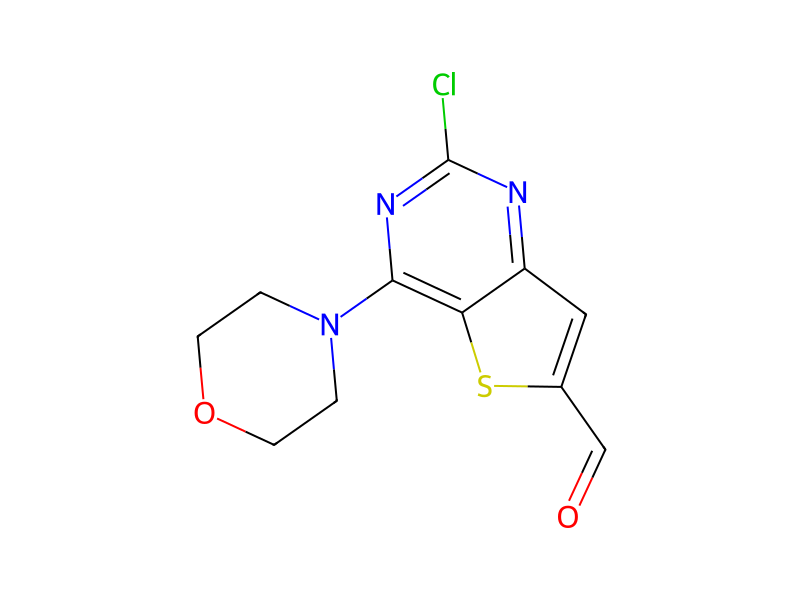


Procedure
To a suspension of 2-chloro-4-morpholin-4-yl-thieno[3,2-d]pyrimidine-6-carbaldehyde (500 mg) in methanol (20 mL) at 0° C. was added sodium borohydride (66 mg). The reaction was stirred for 2 h then quenched with 1:1 saturated aqueous sodium hydrogencarbonate solution water (20 mL). The mixture was stirred for 10 min and then filtered, washed with water and air dried to give (2-chloro-4-morpholin-4-yl-thieno[3,2-d]pyrimidin-6-yl)-methanol as a white solid (489 mg).
Workup
- customthen quenched with 1:1 saturated aqueous sodium hydrogencarbonate solution water (20 mL)
- stirringThe mixture was stirred for 10 min
- filtrationfiltered
- washwashed with water and air
- customdried
Sources & evidence
- ORD record
- ord-850101a1760a4d9c80e148417da4c90f
- Source dataset
- uspto-grants-2013_05
- Patent number
- US08450315B2
Reaction notes
Loading…