Butyric Acid → L-carnitine calcium butyrate
Reaction equation

[OH:1][C@H:2]([CH2:8][C:9](=[O:11])[O-:10])[CH2:3][N+:4]([CH3:7])([CH3:6])[CH3:5].[C:12]([OH:17])(=[O:16])[CH2:13][CH2:14][CH3:15].O.[OH-].[Ca+2:20].[OH-]>CO>[C:9]([O-:11])(=[O:10])[CH2:8][CH2:2][CH3:3].[Ca+2:20].[OH:1][C@H:2]([CH2:8][C:9](=[O:10])[O-:11])[CH2:3][N+:4]([CH3:7])([CH3:5])[CH3:6].[C:12]([O-:17])(=[O:16])[CH2:13][CH2:14][CH3:15]Participants
Reactant 4


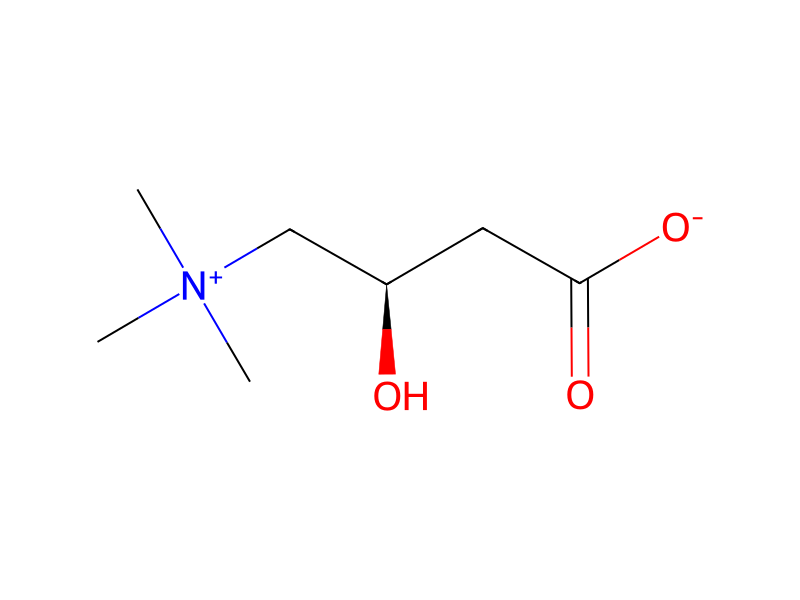

Product 1

Reagents, catalysts & solvents 1

Procedure
L-Carnitine (0.5 g, 0.003 mol) and butyric acid (0.54 g, 0.006 mol) were added to 5 mL of water and 1 mL of methanol. To the resulting solution was added calcium hydroxide (0.22 g, 0.003 mol). The resulting slurry clarified during 15 minutes of stirring at room temperature. After continued stirring at room temperature for four hr, the solution was filtered, and the filtrate was concentrated to dryness under vacuum at bath temperatures that were less than about 70° C. The solid, L-carnitine calcium butyrate, was obtained in greater than 90% yield and had a melting point of 97.6° C., with decomposition and evolution of trimethylamine. (The melting point of L-carnitine was 186-190° C. Butyric acid is a liquid.) The solid was not hygroscopic. The solid had no objectionable taste but had a somewhat bitter aftertaste. The 1H-NMR spectrum (FIG. 2) is consistent with the structure of the salt and shows the presence of L-carnitine and butyrate in a molar ratio of approximately 1:2. (Calcium is not detected by 1H-NMR.)
Workup
- stirringAfter continued stirring at room temperature for four hr
- filtrationthe solution was filtered
- concentrationthe filtrate was concentrated to dryness under vacuum at bath temperatures that
- customwere less than about 70° C
Sources & evidence
- ORD record
- ord-a11d5f4e56064cb0ae9550a76934dd9b
- Source dataset
- uspto-grants-2009_08
- Patent number
- US07572832B2
Reaction notes
Loading…