Oxygen → Hydroperoxide,1,1'-[1,3-phenylenebis(1-methylethylidene)]bis-
Reaction equation

C(C1C=CC=CC=1C(C)C)(C)C.C(C1C=CC=CC=1C(C)C)(C)C.[CH:25]([C:28]1[CH:33]=[CH:32][CH:31]=[C:30]([CH:34]([CH3:36])[CH3:35])[CH:29]=1)([CH3:27])[CH3:26].[O:37]=[O:38].[OH:39][O:40]O.C(C1C=CC=C(C(C)C)C=1)(C)C>>[O-:39][OH:40].[O-:37][OH:38].[CH:34]([C:30]1[CH:31]=[CH:32][CH:33]=[C:28]([CH:25]([CH3:27])[CH3:26])[CH:29]=1)([CH3:36])[CH3:35]Participants
5



Procedure
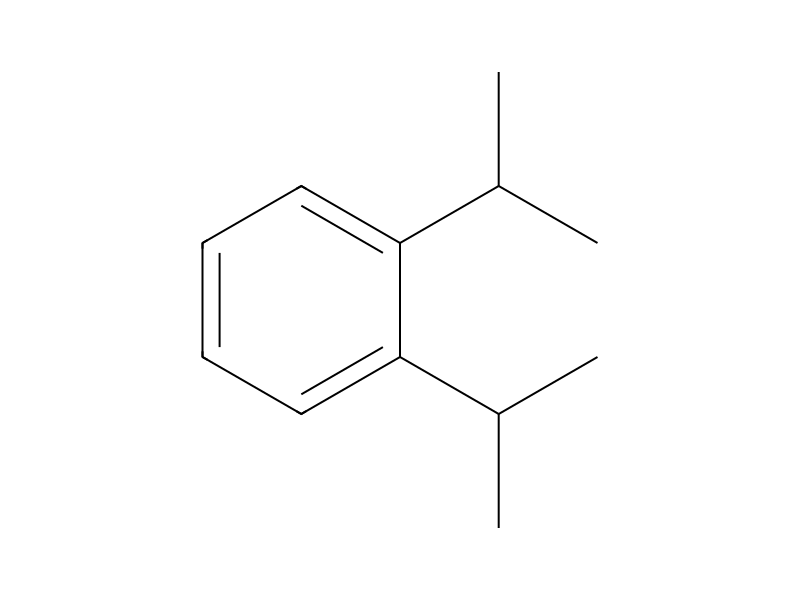
The objects of the present invention are achieved by a process in which diisopropylbenzene, comprised of m-diisopropylbenzene diisopropylbenzene and less than 6% o-diisopropylbenzene, is oxidized under anhydrous, non-alkaline conditions with oxygen or air at about 85° C.-95° C. in a continuous process. The hydroperoxidation method of the present invention produced a 92.8% yield of m-diisopropylbenzene dihydroperoxide (m-DHP) and m-diisopropylbenzene hydroxyhydroperoxide (m-HHP), of which approximately 75% was m-DHP and 25% was m-HHP. Furthermore, the composition remains substantially the same through at least ten cycles of batch operations.
Workup
- customat about 85° C.-95° C.
Sources & evidence
- ORD record
- ord-f0579c3cf4614ebaa04a3568b6032618
- Source dataset
- uspto-grants-1990_06
- Patent number
- US04935551
Reaction notes
Loading…