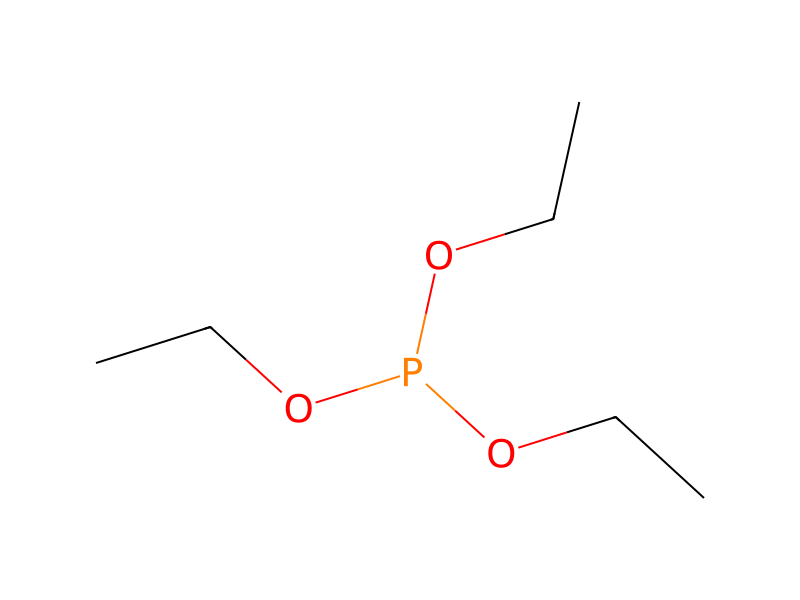
Triethyl phosphite → HCID 86603456, compound
Reaction equation

[Cl:1][C:2]1[CH:3]=[C:4]([CH:7]=[C:8]([Cl:26])[C:9]=1[O:10][C:11]1[CH:16]=[CH:15][C:14]([OH:17])=[C:13]([CH2:18][C:19]2[CH:24]=[CH:23][C:22]([F:25])=[CH:21][CH:20]=2)[CH:12]=1)[CH2:5]Br.[CH2:27]([O:29][P:30]([O:34]CC)[O:31][CH2:32][CH3:33])[CH3:28]>C1(C)C=CC=CC=1>[Cl:1][C:2]1[CH:3]=[C:4]([CH:7]=[C:8]([Cl:26])[C:9]=1[O:10][C:11]1[CH:16]=[CH:15][C:14]([OH:17])=[C:13]([CH2:18][C:19]2[CH:24]=[CH:23][C:22]([F:25])=[CH:21][CH:20]=2)[CH:12]=1)[CH2:5][P:30](=[O:34])([O:31][CH2:32][CH3:33])[O:29][CH2:27][CH3:28]Participants
Reactant 2

Product 1

Reagents, catalysts & solvents 1

Conditions
- Temperature
- 120 °C
Procedure
To a stirred solution of 3,5-dichloro-4-[3′-(4-fluorobenzyl)-4-hydroxyphenoxy] benzyl bromide (0.25 g, 0.55 mmol) in toluene (5 mL) at room temperature was added triethylphosphite (0.91 g, 5.5 mmol). The reaction mixture was heated at 120° C. for 8 h and cooled to room temperature. The solvent was removed under reduced pressure and the crude product was purified by column chromatography on silica gel, eluting with ethyl acetate-hexanes (1:1) to afford diethyl 3,5-dichloro-4-[3′-(4-fluorobenzyl)-4′-hydroxyphenoxy]benzylphosphonate as a colorless oil (0.2 g, 68%): 1H NMR (300 MHz, CDCl3): δ 7.29 (d, J=2.7 Hz, 2H), 7.15 (dd, J=5.4, 9.0 Hz, 2H), 6.95 (t, J=8.7 Hz, 2H), 6.66 (d, J=4.8 Hz, 1H), 6.65 (s, 1H), 6.46 (dd, J=3.0, 8.7 Hz, 1H), 4.07 (q, J=7.2 Hz, 4H), 3.89 (s, 2H), 3.04 (d, J=21.3 Hz, 2H), 1.27 (t, J=7.2 Hz, 3H); TLC conditions: Uniplate silica gel, 250 microns; Mobile phase=ethyl acetate-hexanes (1:1); Rf=0.3.
Workup
- temperaturecooled to room temperature
- customThe solvent was removed under reduced pressure
- customthe crude product was purified by column chromatography on silica gel
- washeluting with ethyl acetate-hexanes (1:1)
Sources & evidence
- ORD record
- ord-49ca477d87474171907403c94351b1f5
- Source dataset
- uspto-grants-2009_04
- Patent number
- US07514419B2
Reaction notes
Loading…