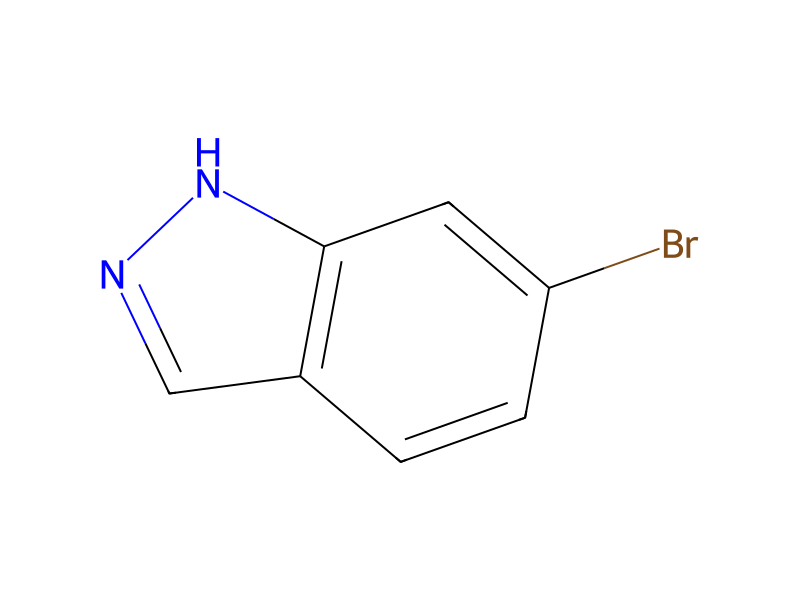
Hydrazine → 6-Bromo-1H-indazole
Reaction equation

[NH2:1][NH2:2].[Br:3][C:4]1[CH:11]=[CH:10][C:7]([CH:8]=O)=[C:6](F)[CH:5]=1>>[Br:3][C:4]1[CH:5]=[C:6]2[C:7]([CH:8]=[N:1][NH:2]2)=[CH:10][CH:11]=1Participants


Conditions
- Temperature
- 125 °C
Procedure
To a 100 mL round-bottomed flask was added hydrazine (30 mL, 832 mmol) and 4-bromo-2-fluorobenzaldehyde (4.69 g, 23 mmol). The solution was stirred at 125° C. for 3 hours. After cooling to ambient temperature, the solution was concentrated under reduced pressure. The solution was quenched by pouring it into a mixture of ice water (100 mL), and then extracting with EtOAc (3×100 mL). The organic layers were combined, dried over sodium sulfate, and filtered. The solution was evaporated to dryness, and adsorbed onto silica gel. The crude product was purified using column chromatography through a Redi-Sep® pre-packed silica gel column (40 g), eluting with a gradient of 0% to 100% EtOAc in hexanes, to provide 6-bromo-1H-indazole (4.6 g, 18 mmol, 76% yield). LCMS (M+H) 197.9 calc. for C7H5BrN2 197.0, 1H NMR (400 MHz, CD3OD): δ ppm 8.03 (s, 1H), 7.67-7.72 (2H, m), 7.24-7.26 (m, 1H).
Workup
- temperatureAfter cooling to ambient temperature
- concentrationthe solution was concentrated under reduced pressure
- customThe solution was quenched
- additionby pouring it
- additioninto a mixture of ice water (100 mL)
- extractionextracting with EtOAc (3×100 mL)
- dry with materialdried over sodium sulfate
- filtrationfiltered
- customThe solution was evaporated to dryness
- customThe crude product was purified
- washeluting with a gradient of 0% to 100% EtOAc in hexanes
Sources & evidence
- ORD record
- ord-40f40fd85ca74fe1abbb74326dd84975
- Source dataset
- uspto-grants-2009_04
- Patent number
- US07514566B2
Reaction notes
Loading…