Imidazole → [(4-Bromo-2-thienyl)methoxy]t-butyldimethylsilane
Reaction equation

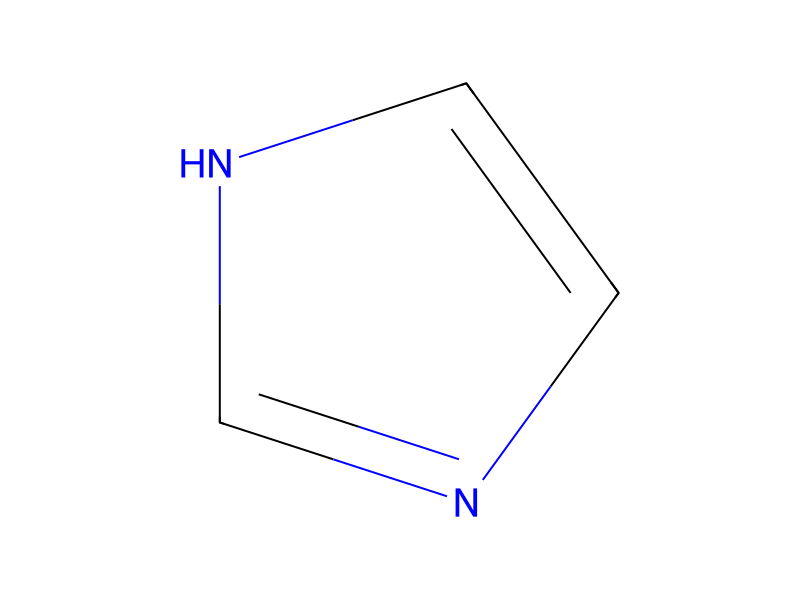
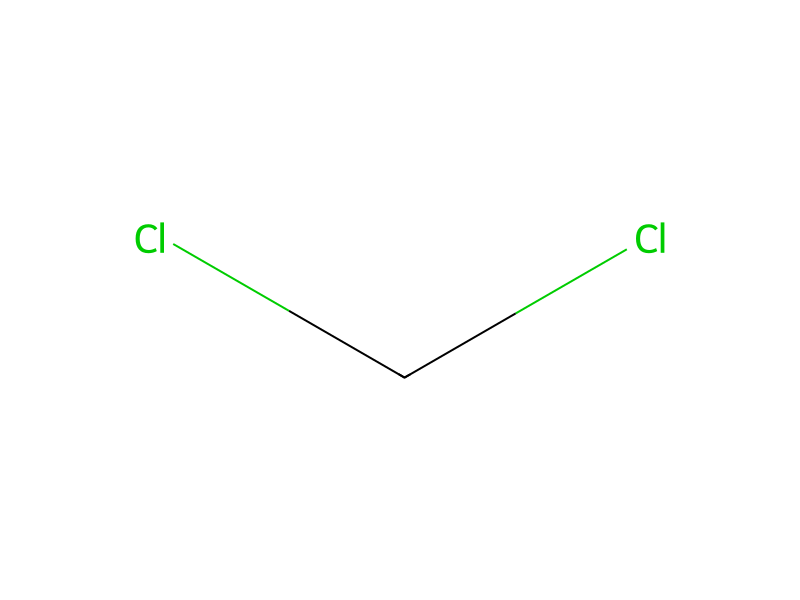
[Br:1][C:2]1[CH:3]=[C:4]([CH2:7][OH:8])[S:5][CH:6]=1.N1C=CN=C1.[Si:14](Cl)([C:17]([CH3:20])([CH3:19])[CH3:18])([CH3:16])[CH3:15]>ClCCl>[Br:1][C:2]1[CH:3]=[C:4]([CH2:7][O:8][Si:14]([C:17]([CH3:20])([CH3:19])[CH3:18])([CH3:16])[CH3:15])[S:5][CH:6]=1Participants
Reactant 3


Product 1

Reagents, catalysts & solvents 1
Procedure
To a solution of (4-bromo-thiophen-2-yl)-methanol (25 g, 130 mmol) in dichloromethane was added imidazole (9.7 g, 142 mmol) followed by tert-butyldimethylsilyl chloride (23.4 g, 156 mmol). The white suspension was stirred at room temperature for 30 minutes. The insoluble was filtered off. The filtrate was concentrated. The residual oil was chromatographed through silica gel (n-heptane/dichloromethane, 90/10 as eluant) to produce (4-bromo-thiophen-2-ylmethoxy)-tert-butyl-dimethyl-silane [34.6 g, Intermediate (67)] as a yellowish oil. LC/MS: 307.0 (M+H), RT=4.38 minutes. Step 2. To a solution of (4-bromo-thiophen-2-ylmethoxy)-tert-butyl-dimethyl-silane [34.6 g, 112.6 mmol, Intermediate (67)] in tetrahydrofuran (100 mL) at 0° C. under nitrogen atmosphere was added a 1.8 M LDA solution in tetrahydrofuran/heptane/ethylbenzene (68.8 mL, 123.9 mmol). Then N-formyl piperidine (15 mL, 135.1 mmol) was added. The dark green mixture was stirred at room temperature overnight and quenched with saturated aqueous ammonium chloride. It was extracted twice with ethyl acetate. The organic layer was dried over magnesium sulfate and concentrated. The residue was chromatographed through silica gel (n-heptane/ethyl acetate, 90/10 as eluant) to afford 3-bromo-5-(tert-butyl-dimethyl-silanyloxymethyl)-thiophene-2-carbaldehyde [30.1 g, 80%, Intermediate (68)]. Step 3. To a solution of 3-bromo-5-(tert-butyl-dimethyl-silanyloxymethyl)-thiophene-2-carbaldehyde [30.1 g, 89.7 mmol, Intermediate (68)] in ethanol (350 mL) was added benzophenone hydrazone (20 g, 104.7 mmol). The resulting yellow solution was stirred at reflux for 6 hours. The solvent was then removed and the residue was chromatographed through silica gel (n-heptane/dichloromethane, 20/80 as eluant) to produce N-benzhydrylidene-N′-[1-[3-bromo-5-(tert-butyl-dimethyl-silanyloxymethyl)-thiophen-2-yl]-methylidene]-hydrazine [41.3 g, Intermediate (69)]. LC/MS: 515.1 (M+H), (2 isomers detected) RT=4.17 minutes and 4.34 minutes. Step 4. To a solution of N-benzhydrylidene-N′-[1-[3-bromo-5-(tert-butyl-dimethyl-silanyloxymethyl)-thiophen-2-yl]-methylidene]-hydrazine [41.2 g, 80.2 mmol, Intermediate (69)] in toluene (500 mL) were added benzophenone hydrazone (18.9 g, 96.2 mmol), cesium carbonate (44.3 g, 136.3 mmol) then 1,1′-diphenylphosphinoferrocene (6.66 g, 12 mmol), and palladium acetate (1.35 g, 6 mmol). The orange mixture was stirred at 90° C. for 20 hours. The insoluble was filtered off and the filtrate was concentrated. The residue was chromatographed (n-heptane/ethyl acetate, 90/10). The resulting dark orange oil (45.7 g) was dissolved in ethanol (400 mL), then concentrated hydrochloric acid (150 mL) was added. The dark red mixture was stirred at 75° C. overnight. A 2.5 N solution of sodium hydroxide in water was added until pH is neutral. The mixture was then extracted twice with ethyl acetate. The organic layer was dried over magnesium sulfate and concentrated. The residue was chromatographed through silica gel (n-heptane/ethyl acetate, 50/50 then 20/80 as eluant) to afford (1H-thieno[3,2-c]pyrazol-5-yl)-methanol [3.3 g, 27%, Intermediate (70)] as an orange powder. Step 5. To a solution of (1H-thieno[3,2-c]pyrazol-5-yl)-methanol [3.2 g, 20.8 mmol, Intermediate (70)] in solution in dimethyl formamide (40 mL) were added potassium hydroxide (3.5 g, 62.3 mmol) and iodine (7.9 g, 31.1 mmol). The mixture was stirred at room temperature for 5 hours. A concentrated solution of sodium bisulfite in water was added until the orange color disappeared. The resulting mixture was extracted several times with ethyl acetate. The combined organic layers were dried over magnesium sulfate and concentrated. The residue was triturated in dichloromethane to produce (3-iodo-1H-thieno[3,2-c]pyrazol-5-yl)-methanol [5.3 g, 91%, Intermediate (71)]. LC/MS: 280.91 (M+H), RT=1.93 minutes; 1H NMR [300 Mhz, (CD3)2SO]: δ13.23 (s, 1H), 7.12 (s, 1H), 5.64 (t, J=6.6 Hz, 1H), 4.63 (d, J=6.5 Hz, 1H). Step 6. To (3-iodo-1H-thieno[3,2-c]pyrazol-5-yl)-methanol [2.89 g, 10.3 mmol, Intermediate (71)] in dimethyl formamide (20 mL) was added imidazole (1.4 g, 20.6 mmol) and tert-butyldimethylsilyl chloride (2.63 g, 17.5 mmol). The resulting solution was stirred at room temperature for 5 minutes. It was then diluted with water and was extracted twice with ethyl acetate. The organic layer was washed with water, dried over magnesium sulfate and concentrated. The residue was chromatographed through silica gel (n-heptane/ethyl acetate, 100/0 then 90/10 then 70/30 as eluant) to produce 5-(tert-butyl-dimethyl-silanyloxymethyl)-3-iodo-1H-thieno[3,2-c]pyrazole [3.5g, 85%, Intermediate (72)] as a white powder. LC/MS: 395.0 (M+H), RT=3.95 minutes. Step 7. To 5-(tert-butyl-dimethyl-silanyloxymethyl)-3-iodo-1H-thieno[3,2-c]pyrazole [3.40 g, 8.62 mmol, Intermediate (72)] in dichloromethane (80 mL) were added DMAP (0.22 g, 1.72 mmol) and ditertbutyl dicarbonate (2.26 g, 10.34 mmol). The mixture was stirred at room temperature for 30 min. The solvent was then removed. The residue was chromatographed through silica gel (dichloromethane as eluant) to produce 5-(tert-butyl-dimethyl-silanyloxymethyl)-3-iodo-thieno[3,2-c]pyrazole-1-carboxylic acid tert-butyl ester [3.57 g, 84%, Intermediate (73)]. LC/MS: 495.07 (M+H), RT=4.37 minutes. ps Step 8. To a solution of 6-(tert-butyl-dimethyl-silanoxy)-1H-indole-2-boronic acid [3.57 g, 9.13 mmol, Intermediate (74), prepared by the application of method described in Example 4-6 of International Patent Application Publication No. WO 02/32861] and 5-(tert-butyl-dimethyl-silanyloxymethyl)-3-iodo-thieno[3,2-c]pyrazole-1-carboxylic acid tert-butyl ester [3.47 g, 7.02 mmol, Intermediate (73)] in solution in 1,4-dioxane (60 mL) was added [1,1′-bis(diphenylphosphino)-ferrocene]dichloropalladium(II) (complex with dichloromethane (1:1)) (385 mg, 0.53 mmol). An aqueous solution (25 mL) of cesium carbonate (9.14 g, 28.08 mmol) was added. The mixture was stirred at 80° C. for 1 hour. It was allowed to cool down to room temperature, and was extracted three times with ethyl acetate. The organic layer was dried over magnesium sulfate and concentrated. The residue was chromatographed through silica gel (n-heptane/ethyl acetate, 95/05 then 90/10) to produce 2-[1-tert-butoxycarbonyl-5-(tert-butyl-dimethyl-silanyloxymethyl)-1H-thieno[3,2-c]pyrazol-3-yl]-6-(tert-butyl-dimethyl-silanyloxy)-indole-1-carboxylic acid tert-butyl ester [3.8 g, 76%, Intermediate (75)]. LC/MS: 714.38 (M+H), RT=3.27 minutes. Step 9. To a solution of 2-[1-tert-butoxycarbonyl-5-(tert-butyl-dimethyl-silanyloxymethyl)-1H-thieno[3,2-c]pyrazol-3-yl]-6-(tert-butyl-dimethyl-silanyloxy)-indole-1-carboxylic acid tert-butyl ester [3.2 g, 4.5 mmol, Intermediate (75)] in tetrahydrofuran (30 mL) at 0° C. was added a 1.0 M TBAF solution in tetrahydrofuran. The green solution was stirred at 0° C. until the reaction is complete and was then diluted with water. The resulting mixture was extracted with ethyl acetate. The organic layer was dried over magnesium sulfate and concentrated. The residue was chromatographed through silica gel (dichloromethane/ethyl acetate, 90/10 as eluant) to produce 2-(1-tert-butoxycarbonyl-5-hydroxymethyl-1H-thieno[3,2-c]pyrazol-3-yl)-6-hydroxy-indole-1-carboxylic acid tert-butyl ester [1.5 g (66%, Intermediate (76)]. LC/MS: 486.2 (M+H), RT=3.30 minutes. Step 10. To a suspension of 2-(1-tert-butoxycarbonyl-5-hydroxymethyl-1H-thieno[3,2-c]pyrazol-3-yl)-6-hydroxy-indole-1-carboxylic acid tert-butyl ester [1.45 g, 2.99 mmol, Intermediate (76)] in 1,3 dibromopropane (5 mL) was added cesium carbonate (2.43 g, 7.48 mmol). The suspension was stirred at 80° C. for 3 hours. It was allowed to cool down to room temperature. The insoluble was filtered off. The filtrate was loaded on silica gel for chromatography (n-heptane/ethyl acetate, 100/0 then gradually to 65/35 as eluant) to produce 6-(3-bromo-propoxy-2-(1-tert-butoxycarbonyl-5-hydroxymethyl-1H-thieno[3,2-c]pyrazol-3-yl)-indole-1-carboxylic acid tert-butyl ester [990 mg, 55%, Intermediate (77)]. LC/MS: 606.1 (M+H), RT=3.22 minutes. Step 11. To 6-(3-bromo-propoxy)-2-(1-tert-butoxycarbonyl-5-hydroxymethyl-1H-thieno[3,2-c]pyrazol-3-yl)-indole-1-carboxylic acid tert-butyl ester [160 mg, 0.26 mmol, Intermediate (77)] in acetonitrile (4 mL) were added polymer supported DIEA (3.86 mmol/g, 135 mg, 0.52 mmol) and piperidine (52 μL, 0.52 mmol). The mixture was stirred gently at 75° C. for 3 hours. The PS-DIEA was filtered and the solvent was removed. The residue was chromatographed through silica gel (dichloromethane/1.0M ammonia in methanol, 90/10 as eluant) to produce a yellow oil. It was dissolved in dichloromethane (1 mL). Anisole (0.5 mL) then trifluoroacetic acid (0.5 mL) were added. The resulting yellow solution was stirred at 45° C. overnight then directly loaded onto a cationic exchange column (VARIAN, mega bond elut, 5 g) washed with methanol and eluted with 1.0M ammonia in methanol. The appropriate fractions were combined and concentrated. The residue was triturated in dichloromethane to afford {3-[6-(3-piperidin-1-yl-propoxy)-1H-indol-2-yl]-1H-thieno[3,2-c]pyrazol-5-yl}-methanol [91 mg, 84%, Example 62] as a white powder. LC/MS: 411.3 (M+H), RT=2.42 minutes; 1H NMR [300 Mhz, (CD3)2SO]: δ 13.05 (s, 1H), 11.33 (s, 1H), 7.42 (d, J=8.5 Hz, 1H), 7.05 (s, 1H), 6.91 (s, 1H), 6.65 (dd, J1=8.5 Hz, J2=1.7 Hz, 1H), 6.52 (s, 1H), 5.65 (t, J=5.7 Hz, 1H), 4.70 (d, J=5.5 Hz, 2H), 3.99 (t, J=6.2 Hz, 2H), 2.45-2.36 (m, 6H), 1.89 (quint, J=6.7Hz, 2H), 1.49 (d, J=5.0 Hz, 4H), 1.39 (d, J=5.2 Hz, 2H).
Workup
- filtrationThe insoluble was filtered off
- concentrationThe filtrate was concentrated
- customThe residual oil was chromatographed through silica gel (n-heptane/dichloromethane, 90/10 as eluant)
Sources & evidence
- ORD record
- ord-1bf5f4723b7549b9b632d442bfe7bf9e
- Source dataset
- uspto-grants-2009_04
- Patent number
- US07518000B2
Reaction notes
Loading…