Acetone → 5-(4-Bromophenyl)-2,2-dimethyl-1,3-dioxolan-4-one
Reaction equation

[Br:1][C:2]1[CH:7]=[CH:6][C:5]([CH:8]([OH:12])[C:9]([OH:11])=[O:10])=[CH:4][CH:3]=1.S(=O)(=O)(O)O.C(=O)([O-])[O-].[Na+].[Na+].[CH3:24][C:25]([CH3:27])=O>O>[Br:1][C:2]1[CH:3]=[CH:4][C:5]([CH:8]2[O:12][C:25]([CH3:27])([CH3:24])[O:10][C:9]2=[O:11])=[CH:6][CH:7]=1Participants
6
Reactant 4



Product 1

Reagents, catalysts & solvents 1

Conditions
- Temperature
- -10 °C
Procedure
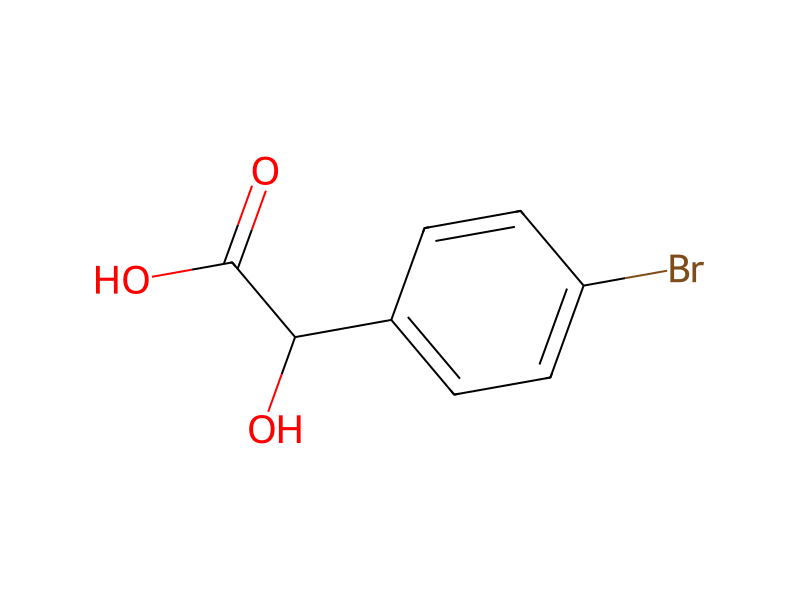
2-(4-Bromophenyl)-2-hydroxyacetic acid (97 g; 0,42 mol) is dissolved in 200 ml of acetone and the solution is cooled to −10° C. At this temperature 23 ml of concentrated sulfuric acid are added dropwise. After the addition is complete the reaction mixture is stirred at −10° C. for further 30 minutes and is subsequently poured into a cooled (0° C.) solution of sodium carbonate (86 g; 0,81 mol) in 800 ml of water. The crystalline 5-(4-bromophenyl)-2,2-dimethyl-1,3-dioxolan-4-one is filtered, washed with ice-cold water and dried in the high vacuum.
Workup
- additionAfter the addition
- additionis subsequently poured into
- filtrationThe crystalline 5-(4-bromophenyl)-2,2-dimethyl-1,3-dioxolan-4-one is filtered
- washwashed with ice-cold water
- customdried in the high vacuum
Sources & evidence
- ORD record
- ord-b7e7fc76fd4d4c2b93eec2d7332d4991
- Source dataset
- uspto-grants-2009_04
- Patent number
- US07521579B2
Reaction notes
Loading…