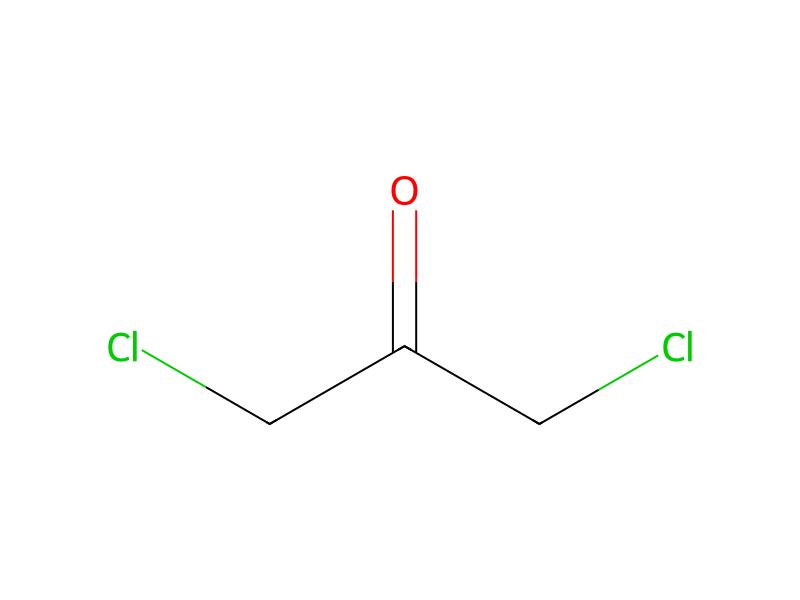
1,3-Dichloroacetone → HCID 69292417, compound
Reaction equation

[F:1][C:2]1([F:16])[O:6][C:5]2[CH:7]=[CH:8][C:9]([CH:11]=[CH:12][C:13]([NH2:15])=[O:14])=[CH:10][C:4]=2[O:3]1.[Cl:17][CH2:18][C:19]([CH2:21]Cl)=O>C1(C)C=CC=CC=1>[Cl:17][CH2:18][C:19]1[N:15]=[C:13]([CH:12]=[CH:11][C:9]2[CH:8]=[CH:7][C:5]3[O:6][C:2]([F:1])([F:16])[O:3][C:4]=3[CH:10]=2)[O:14][CH:21]=1Participants
4
Reactant 2

Product 1

Reagents, catalysts & solvents 1

Procedure
6.90 g (30.4 mmol) 3-(2,2-Difluoro-benzo[1,3]dioxol-5-yl)-acrylamide, 4.76 g (37.5 mmol) 1,3-dichloroacetone and 50 ml toluene were kept at reflux temperature for 48 h with continuous removal of water by applying a Dean-Stark trap. After removal of solvents in vacuo, the residue was treated with 60 ml of a 1:1 mixture of water/isopropanol. After filtration the precipitate was washed first with isopropanol, then with heptane. Drying at 40° C. in vacuo gave 4-Chloromethyl-2-[2-(2,2-difluoro-benzo[1,3]dioxol-5-yl)-vinyl]-oxazole.
Workup
- temperatureat reflux temperature for 48 h
- customwith continuous removal of water
- customAfter removal of solvents in vacuo
- additionthe residue was treated with 60 ml of a 1:1 mixture of water/isopropanol
- filtrationAfter filtration the precipitate
- washwas washed first with isopropanol
- customDrying at 40° C. in vacuo
Sources & evidence
- ORD record
- ord-bb5a744eb9784741abd429926d38b2b4
- Source dataset
- uspto-grants-2008_10
- Patent number
- US07432291B2
Reaction notes
Loading…