Acetone → Allylamine hydrochloride
Reaction equation

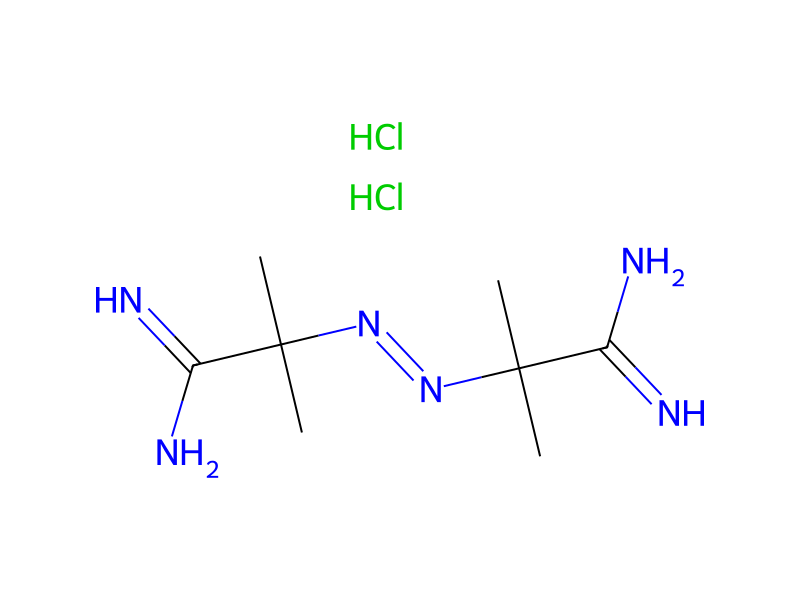
[ClH:1].Cl.N([C:11]([C:14](=[NH:16])N)([CH3:13])C)=N[C:5]([C:8](=N)[NH2:9])(C)[CH3:6].[CH3:17][C:18](C)=O>>[ClH:1].[CH2:17]([CH:13]=[CH:11][CH2:14][NH2:16])[CH3:18].[ClH:1].[CH2:8]([NH2:9])[CH:5]=[CH2:6]Participants



Conditions
- Temperature
- 60 °C
Procedure
A 64.2% aqueous solution of N-ethylallylamine hydrochloride (hereinafter, abbreviated as EAA.HCl) was propared by adding 52.1 g of 35% hydrochloric acid to 42.58 g (0.5 mole) of N-ethylallylamine while cooling the reaction mixture. On the other hand, 28.54 g (0.5 mole) of allylamine was neutralized with 52.1 g of 35% hydrochloric acid while cooling the reaction mixture, and then the mixture was concentrated by means of rotary evaporator to obtain a 69.8% aqueous solution of allylamine hydrochloride (hereinafter, abbreviated as AA.HCl). Then, 18.94 g of the aqueous solution of EAA.HCl and 13.40 g of aqueous solution of AA.HCl, obtained above, were mixed together and heated to 60° C. Then, 0.645 g of 2,2'-azobis(2-amidinopropane) dihydrochloride was added, and a polymerization reaction was carried out at that temperature for 48 hours. After the reaction, the reaction mixture (a solution) was poured into a large amount of acetone to precipitate the reaction product. The precipitate was collect by filtration using a glass filter and dried at 50° C. under reduced pressure. Thus, a copolymer of N-ethylallylamine hydrochloride and allylamine hydrochloride was obtained.
Workup
- additionwere mixed together
- customa polymerization reaction
- customAfter the reaction
- customto precipitate the reaction product
- filtrationThe precipitate was collect by filtration
- filtrationfilter
- customdried at 50° C. under reduced pressure
Sources & evidence
- ORD record
- ord-fb060b2d701047c980abb8e95ade938d
- Source dataset
- uspto-grants-1987_07
- Patent number
- US04678474
Reaction notes
Loading…