HuagongsheHuagongshe Chemistry Print Report · For research reference only
HRID 2118940Generated: October 27, 2026
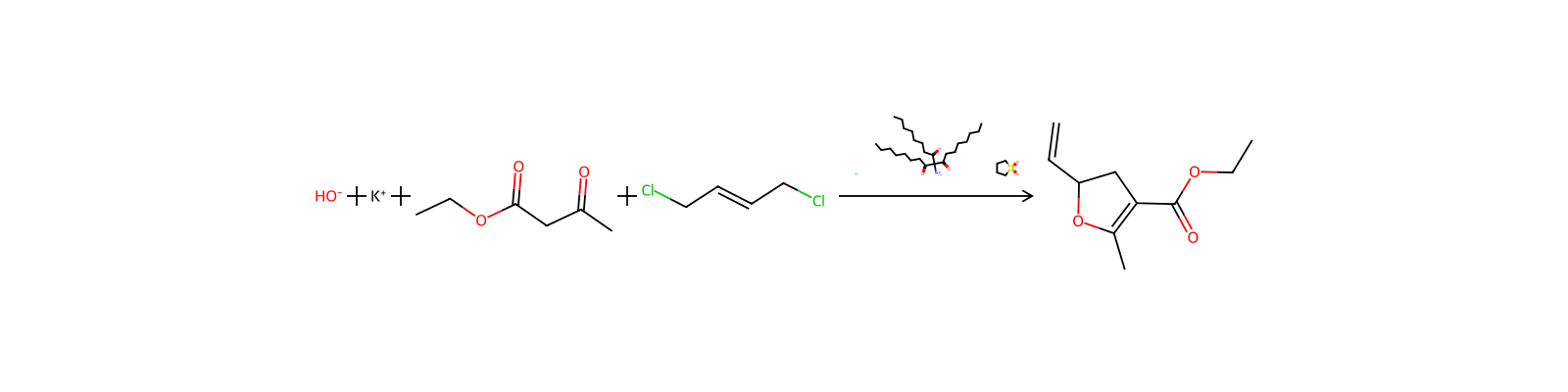
Ethyl Acetoacetate → Ethyl 5-ethenyl-2-methyl-4,5-dihydrofuran-3-carboxylate
https://huagongshe.com/reaction/2118940
Participants
| Role | Name | HCID | Charge |
|---|
| Reactant | Ethyl Acetoacetate | HCID 8868 | — |
| Reactant | Potassium Hydroxide | HCID 14797 | — |
| Reactant | 1,4-Dichloro-2-butene, (2E)- | HCID 642197 | — |
| Catalyst | Tricaprylylmethyl ammonium chloride | HCID 77620884 | — |
| Solvent | Sulfolane | HCID 31347 | — |
| Product | Ethyl 5-ethenyl-2-methyl-4,5-dihydrofuran-3-carboxylate | HCID 12573427 | 65.9% |
Reaction Steps
4-Carbethoxy-5-methyl-2-vinyl-2,3-dihydrofuran was prepared using a phase transfer procedure similar to that of Example I. For the reaction, three grams tricaprylylmethylammonium chloride, 62 grams potassium hydroxide, and 100 mls sulfolane were charged to a reactor and a mixture of 65 grams ethyl acetoacetate and 95 grams 1,4-dichlorobutene-2 slowly added over a period of one hour while maintaining the temperature below 30° C. The mixture was then stirred for two hours at ambient temperature and then heated to 150° C. until the reaction was essentially complete. The reaction mixture was poured into ice-water, extracted with ether, and the ether evaporated using a rotary evaporator. The resulting product, which consisted of essentially a 1:1 mixture of 4-carbethoxy-5-methyl-2-vinyl-2,3-dihydrofuran and ethyl-1-acetyl-2-vinylcyclopropane-1-carboxylate, was distilled. Sixty grams of the 4-carbethoxy-5-methyl-2-vinyl-2,3-dihydrofuran obtained from the distillation was combined with 100 mls ethyl acetate and 0.4 grams supported hydrogenation catalyst (5% Pd on carbon) and hydrogenated in the usual manner. The catalyst was removed at the conclusion of the hydrogenation by filtration and ethyl acetate stripped under reduced pressure to obtain crude 4-carbethoxy-2-ethyl-5-methyl-2,3-dihydrofuran. Distillation of the crude product yielded essentially pure 4-carbethoxy-2-ethyl-5-methyl-2,3-dihydrofuran with chemical and physical properties and fragrance characteristics the same as described for the product of Example IX.
Provenance & Evidence
| DOI | 10.6084/m9.figshare.5104873.v1 |
|---|
| Patent number | US04681703 |
|---|
| Source dataset | uspto-grants-1987_07 |
|---|
| ORD ID | ord-9774b18d09e348188c5359c33d12bea7 |
|---|
| Source note | uspto-grants-1987_07 |
|---|