3-Hydroxybenzyl alcohol → Aspirin
Reaction equation

[OH:1]CC1C=C(O)C=CC=1.[C:10]([O:13][C:14]1[C:15](=[CH:19][CH:20]=[CH:21][CH:22]=1)[C:16](Cl)=[O:17])(=[O:12])[CH3:11]>[Na+].[OH-].ClCCl>[C:10]([O:13][C:14]1[CH:22]=[CH:21][CH:20]=[CH:19][C:15]=1[C:16]([OH:1])=[O:17])(=[O:12])[CH3:11]Participants
5
Reactant 2
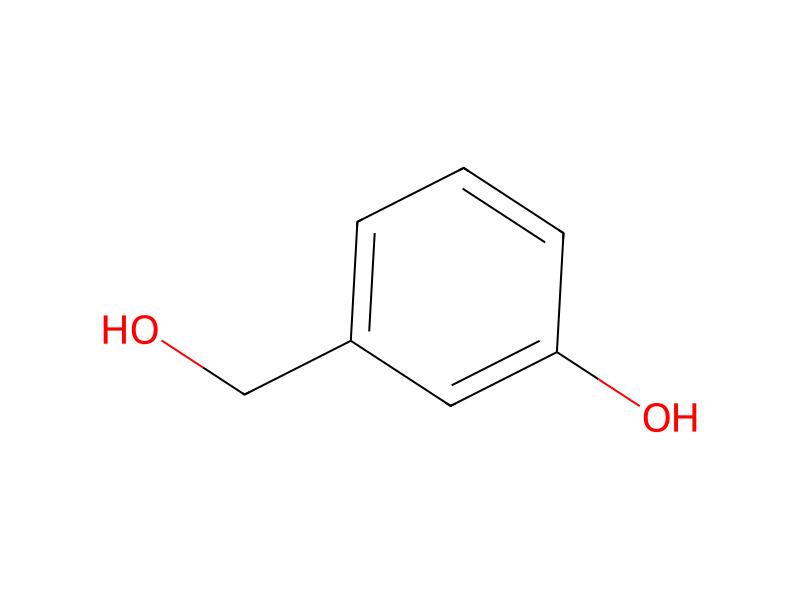

Product 1

Reagents, catalysts & solvents 2


Procedure
3-hydroxymethylphenol (25.25 g, 0.2 moles) is dissolved in a 5% hydroxide sodium solution (160 ml). To the so obtained solution an acetylsalicylic acid chloride solution (40.4 g, 0.2 moles) in dichloromethane (50 ml) is added at roam temperature, under stirring. The mixture is maintained at room temperature under stirring for 2 hours and then extracted with dichloromethane (2×100 ml). The organic phase is separated, anhydrified with sodium sulphate and the solvent evaporated under vacuum. The residue is crystallized from a mixture of ethyl acetate and hexane. 3-hydroxymethylphenyl ester of the 2-acetoxybenzoic acid (45.8 g, 0.16 moles, yield 80%) is obtained.
Workup
- stirringunder stirring for 2 hours
- extractionextracted with dichloromethane (2×100 ml)
- customThe organic phase is separated
- customthe solvent evaporated under vacuum
- customThe residue is crystallized from a mixture of ethyl acetate and hexane
Sources & evidence
- ORD record
- ord-cc238c1a6532475ca2e1846dd4280340
- Source dataset
- uspto-grants-2004_02
- Patent number
- US06696591B1
Reaction notes
Loading…