1-Butene → Norbornene 1-Butene
Reaction equation

[CH:1]12[CH2:7][CH:4]([CH2:5][CH2:6]1)[CH:3]=[CH:2]2.[CH2:8]=[CH:9][CH2:10][CH3:11].[I-].C([Al+]CC)C>C1C=CC=CC=1>[CH:1]12[CH2:7][CH:4]([CH2:5][CH2:6]1)[CH:3]=[CH:2]2.[CH2:8]=[CH:9][CH2:10][CH3:11]Participants
Reactant 3
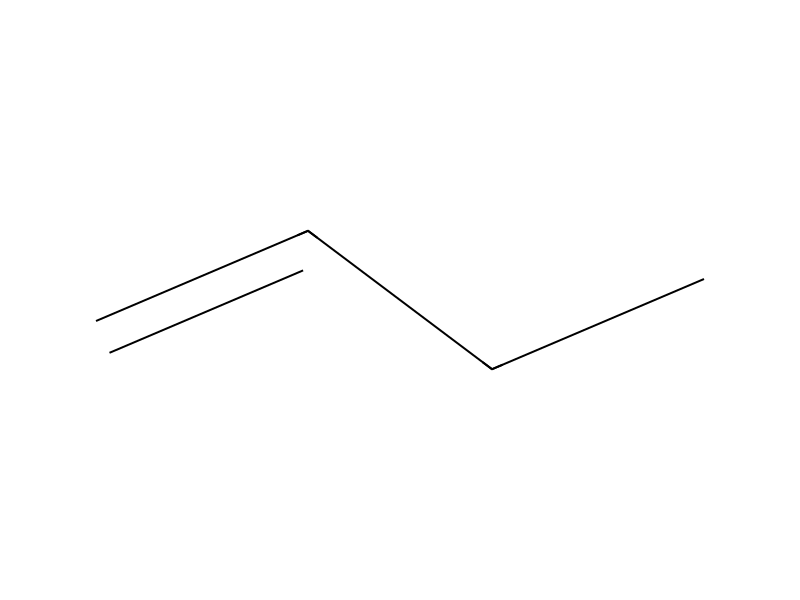


Product 1

Reagents, catalysts & solvents 1

Procedure
500 ml dry benzene cosolvent, 77 ml 2-norbornene solution, 10 ml of the 1-butene solution, and 6 ml of the diethylaluminum iodide solution were charged to a dry, nitrogen-purged quart bottle. 7.5 ml of the MoCl5 solution was charged last, and the bottle was shaken. Polymerization occurred so rapidly that the reaction was terminated after 7-8 minutes using a mixture of 1.5 ml ethanolamine, 10 ml of an antioxidant solution (10 grams of 2,2',2"-tris[3(3,5-di-t-butyl-4-hydroxyphenyl) propionyloxy] ethyl isocyanurate in 100 ml benzene) and 1 ml ethanol. The polymer cement was allowed to stand for about 12 hours and coagulated using excess Solution A in a Waring blender. A slightly yellow solid formed and was filtered and vacuum dried at 60° C. The solid weighed 57.4 grams after drying. It was a ring-opened 2-norbornene/1-butene copolymer having a DSV of about 2.3.
Workup
- custompurged quart bottle
- addition7.5 ml of the MoCl5 solution was charged last
- customPolymerization
- customwas terminated after 7-8 minutes
- additiona mixture of 1.5 ml ethanolamine, 10 ml of an antioxidant solution (10 grams of 2,2',2"-tris[3(3,5-di-t-butyl-4-hydroxyphenyl) propionyloxy] ethyl isocyanurate in 100 ml benzene) and 1 ml ethanol
- customA slightly yellow solid formed
- filtrationwas filtered
- customvacuum dried at 60° C
- customafter drying
Sources & evidence
- ORD record
- ord-5761063912194cd2af00e6a1c6c2c493
- Source dataset
- uspto-grants-1979_01
- Patent number
- US04136248
Reaction notes
Loading…