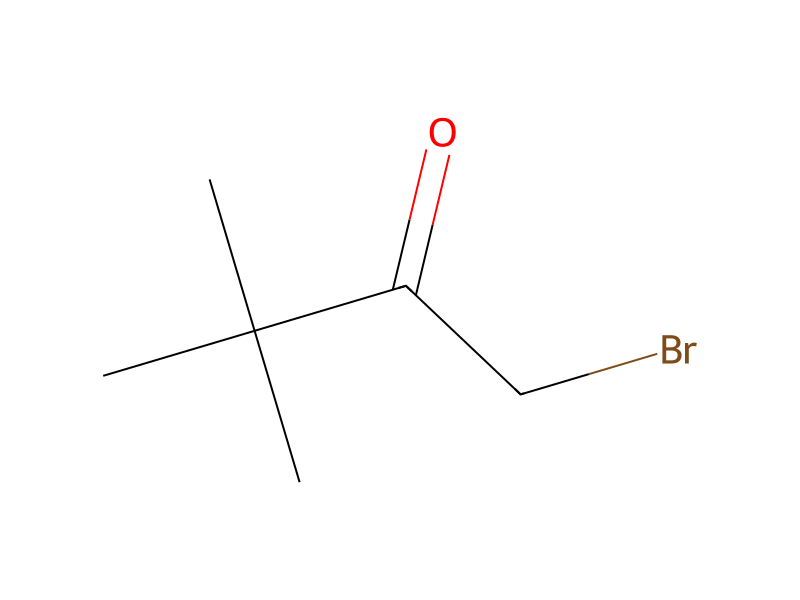
Bromopinacolone → 2-Butanone, 1-(4-chlorophenoxy)-3,3-dimethyl-
Reaction equation

[Cl:1][C:2]1[CH:7]=[CH:6][C:5]([O-:8])=[CH:4][CH:3]=1.[Na+].[CH3:10][C:11]([C:14]([CH2:16]Br)=[O:15])([CH3:13])[CH3:12]>>[Cl:1][C:2]1[CH:7]=[CH:6][C:5]([O:8][CH2:16][C:14](=[O:15])[C:11]([CH3:13])([CH3:12])[CH3:10])=[CH:4][CH:3]=1Participants


Procedure
226 g (1 mol) of 1-(4-chlorophenoxy)-3,3-dimethylbutan-2-one (obtained from sodium 4-chlorophenolate and α-bromopinacolone; in this respect, see German Patent Specification No. 2,201,063), together with 120 g (1.07 mols) of glycerol, 19 g (0.1 mol) of p-toluenesulphonic acid monohydrate and 30 ml of butanol, are dissolved in 1,000 ml of toluene, and the mixture is heated under reflux for 16 hours in a water separator. After the mixture has been cooled, the toluene phase is washed with 4 times 250 ml of water, dried over magnesium sulphate, filtered, and evaporated down in vacuo. 186 g (65.4% of theory) of 2-(t-butyl)-2-(4-chlorophenoxymethyl)-4-hydroxymethyl-1,3-dioxolane of boiling point b.p. 0.1 : 161° C.-163° C. are obtained by distillation.
Sources & evidence
- ORD record
- ord-9c790ca34ad24bf88bad6c407c6c89b6
- Source dataset
- uspto-grants-1985_03
- Patent number
- US04503059
Reaction notes
Loading…