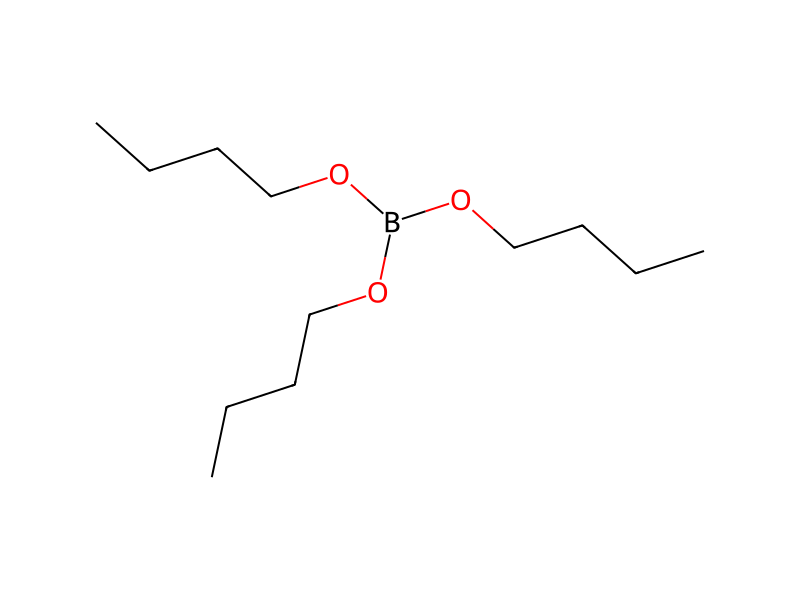
Tributyl borate → Dibutyl 2,6-di-tert-butyl-4-tolyl orthoborate
Reaction equation

[C:1]([C:5]1[CH:10]=[C:9]([CH3:11])[CH:8]=[C:7]([C:12]([CH3:15])([CH3:14])[CH3:13])[C:6]=1[OH:16])([CH3:4])([CH3:3])[CH3:2].[B:17](OCCCC)([O:23][CH2:24][CH2:25][CH2:26][CH3:27])[O:18][CH2:19][CH2:20][CH2:21][CH3:22]>>[B:17]([O:23][CH2:24][CH2:25][CH2:26][CH3:27])([O:18][CH2:19][CH2:20][CH2:21][CH3:22])[O:16][C:6]1[C:5]([C:1]([CH3:4])([CH3:3])[CH3:2])=[CH:10][C:9]([CH3:11])=[CH:8][C:7]=1[C:12]([CH3:15])([CH3:14])[CH3:13]Participants
3


Procedure
In a moisture-protected atmosphere, 2,6-di-tert-butyl-4-methylphenol (1543 g) was heated to 245° C. and while stirring tributyl borate (805.5 g) was slowly added drop by drop. The addition rate was controlled to maintain the reaction temperature at 230°-250° C. and butanol was distilled from the mixture as formed. The distillate was fractionated to separate butanol from tributyl borate and the latter was recycled to the reacting mixture. The reaction mixture was heated at 250°-260° C. until no further distillation was observed.
Workup
- temperatureto maintain the reaction temperature at 230°-250° C.
- distillationbutanol was distilled from the mixture
- customas formed
- customto separate butanol from tributyl borate
- temperatureThe reaction mixture was heated at 250°-260° C. until no further distillation
Sources & evidence
- ORD record
- ord-282a9e8886a349f2a29a8d0d69d5d932
- Source dataset
- uspto-grants-1985_03
- Patent number
- US04507216
Reaction notes
Loading…