Triethyl phosphite → HCID 11780739, compound
Reaction equation

[P:1]([O:8][CH2:9][CH3:10])([O:5][CH2:6][CH3:7])[O:2]CC.Cl[CH2:12]/[CH:13]=[C:14](\[CH3:21])/[CH2:15][CH2:16][CH:17]=[C:18]([CH3:20])[CH3:19]>>[CH3:21]/[C:14](/[CH2:15][CH2:16][CH:17]=[C:18]([CH3:20])[CH3:19])=[CH:13]\[CH2:12][P:1](=[O:2])([O:5][CH2:6][CH3:7])[O:8][CH2:9][CH3:10]Participants
3
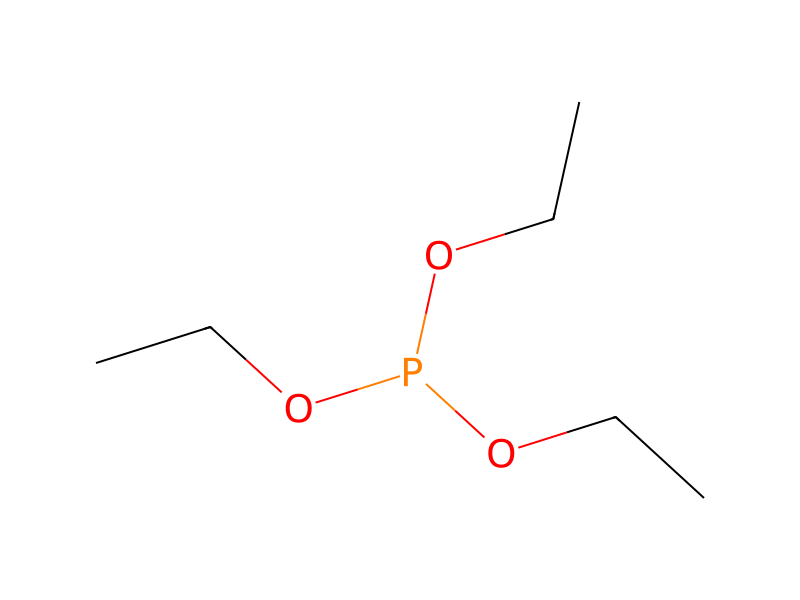


Procedure
To a four-neck 1000 mL reaction flask with mechanical stirrer and thermometer 250 g of triethyl phosphite was added and heated to 150° C.-155° C., then a mixture of 172.7 g (E)-1-Chloro-3,7-dimethyl-2,6-octadiene and 160 g triethyl phosphite was added drop wise. The resulting mixture was stirred at 150° C.-155° C. for an additional 2 h to complete the reaction according to GC. Then cooling the mixture to room temperature, the excessive triethyl phosphite was recycled by vacuum distillation, and 272.8 g of distillate (105-109° C./1 mmHg) was collected as a light yellow transparent liquid with the content of 98.8% according to GC and the yield of 92.1%.
Workup
- customTo a four-neck 1000 mL reaction flask with mechanical stirrer
- temperatureheated to 150° C.-155° C.
- additionwas added drop wise
- distillationthe excessive triethyl phosphite was recycled by vacuum distillation, and 272.8 g of distillate (105-109° C./1 mmHg)
- customwas collected as a light yellow transparent liquid with the content of 98.8%
Sources & evidence
- ORD record
- ord-b94eb2764d33451a85ceb76b37ed5b0a
- Source dataset
- uspto-grants-2015_06
- Patent number
- US09051254B2
Reaction notes
Loading…