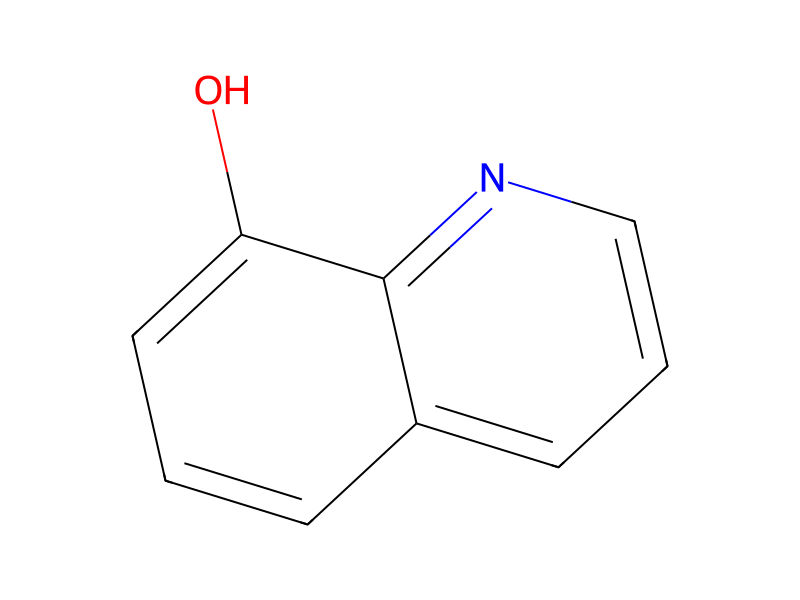
8-Hydroxyquinoline → HCID 86723571, compound
Reaction equation

[Cl:1][C:2]1[CH:7]=[C:6](I)[C:5]([F:9])=[CH:4][N:3]=1.[CH:10]1([C:13]2[N:14]=[CH:15][NH:16][CH:17]=2)[CH2:12][CH2:11]1.OC1C=CC=C2C=1N=CC=C2.C(=O)([O-])[O-].[Cs+].[Cs+]>C(#N)CCC>[Cl:1][C:2]1[CH:7]=[C:6]([N:16]2[CH:17]=[C:13]([CH:10]3[CH2:12][CH2:11]3)[N:14]=[CH:15]2)[C:5]([F:9])=[CH:4][N:3]=1Participants



Procedure
A suspension 2-chloro-5-fluoro-4-iodopyridine (1.8 g, 1.00 mmol), 4-cyclopropyl imidazole (982 mg, 9.10 mmol), Cu2O (100 mg, 0.700 mmol), 8-hydroxyquinoline (152 mg, 1.05 mmol), cesium carbonate (4.60 g, 14.0 mmol), and PEG-3350 (1.4 g) in butyronitrile (50 mL) was heated at 65° C. for 16 hours. The reaction mixture was filtered through Celite, concentrated and the residue was partitioned between dichlormethane and water. The layers were separated and the aqueous layer washed twice with dichloromethane. The combined organic layers were dried (MgSO4), filtered and concentrated. The residue was purified by flash chromatography (15→60% EtOAc in hexanes) to afford 2-chloro-4-(4-cyclopropyl-1H-imidazol-1-yl)-5-fluoropyridine (702 mg, 42% yield).
Workup
- filtrationThe reaction mixture was filtered through Celite
- concentrationconcentrated
- customthe residue was partitioned between dichlormethane and water
- customThe layers were separated
- washthe aqueous layer washed twice with dichloromethane
- dry with materialThe combined organic layers were dried (MgSO4)
- filtrationfiltered
- concentrationconcentrated
- customThe residue was purified by flash chromatography (15→60% EtOAc in hexanes)
Sources & evidence
- ORD record
- ord-fb2f3765e55148958998835de57f991c
- Source dataset
- uspto-grants-2015_06
- Patent number
- US09051313B2
Reaction notes
Loading…