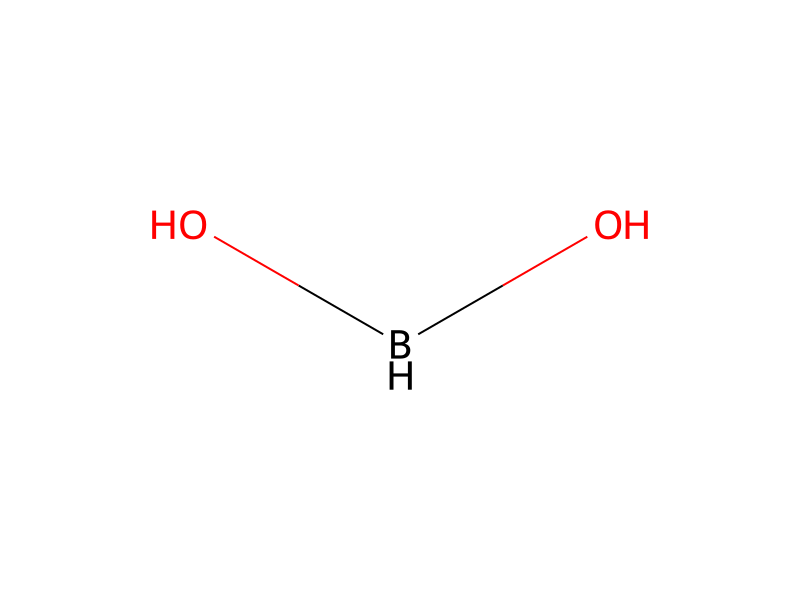
Boronic Acid → HCID 131732938, compound
Reaction equation

BrC1C=CC(F)=C2C=1CC[C@H:6]2[O:12]C1C=CC2[C@H](CC(O)=O)COC=2C=1.FC1[CH:28]=[CH:29][C:30]([B:50]2[O:54][C:53]([CH3:56])([CH3:55])[C:52]([CH3:58])([CH3:57])[O:51]2)=[C:31]2[C:35]=1[C@H:34]([O:36][C:37]1[CH:49]=[CH:48][C:40]3[C@H](CC(O)=O)COC=3C=1)[CH2:33][CH2:32]2.B(O)O>>[CH3:32][C:31]1[CH:35]=[C:34]([CH:33]=[C:29]([CH3:28])[C:30]=1[B:50]1[O:51][C:52]([CH3:57])([CH3:58])[C:53]([CH3:55])([CH3:56])[O:54]1)[O:36][CH2:37][CH2:49][CH:48]([CH3:40])[CH2:6][OH:12]Participants


Procedure
Examples 53, 54, and 55 are also obtained via coupling {(S)-6-[(R)-4-bromo-7-fluoroindan-1-yloxy]-2,3-dihydrobenzofuran-3-yl}-acetic acid (Example 63) or {(S)-6-[(R)-7-fluoro-4-(4,4,5,5-tetramethyl-[1,3,2]dioxaborolan-2-yl)-indan-1-yloxy]-2,3-dihydrobenzofuran-3-yl}-acetic acid with the corresponding coupling partner bearing a metal or pseudo-metal group, e.g., boronic acid or ester, or a leaving group, e.g., Cl or Br, at the carbon to be coupled. Accordingly, Example 53 is obtained from, e.g., 4-[3,5-dimethyl-4-(4,4,5,5-tetramethyl-[1,3,2]dioxaborolan-2-yl)-phenoxy]-2-methylbutanol or the corresponding boronic acid (Intermediate 23) and [(S)-6-((R)-4-bromo-7-fluoroindan-1-yloxy)-2,3-dihydrobenzofuran-3-yl]-acetic acid (e.g., as acid or the piperazinium or morpholinium salt) or from, e.g., 4-(4-bromo-3,5-dimethylphenoxy)-2-methylbutanol and {(S)-6-[(R)-7-fluoro-4-(4,4,5,5-tetramethyl-[1,3,2]dioxaborolan-2-yl)-indan-1-yloxy]-2,3-dihydrobenzofuran-3-yl}-acetic acid (e.g., as acid or the piperazinium or morpholinium salt), as described below.
Workup
- customExamples 53, 54, and 55 are also obtained
Sources & evidence
- ORD record
- ord-6f71b6f9f5f341a3945710c77ddc499f
- Source dataset
- uspto-grants-2015_06
- Patent number
- US09051289B2
Reaction notes
Loading…