Pyridine → HCID 66978156, compound
Reaction equation

[C:1]([C:3]1[CH:11]=[CH:10][C:6]([C:7](Cl)=[O:8])=[CH:5][CH:4]=1)#[N:2].O[NH:13][C:14]([C:16]1[CH:21]=[CH:20][C:19]([C:22]2[CH:27]=[CH:26][C:25]([O:28][CH2:29][CH2:30][CH2:31][C:32]([OH:34])=[O:33])=[CH:24][CH:23]=2)=[CH:18][CH:17]=1)=[NH:15].N1C=CC=CC=1>O1CCOCC1>[C:1]([C:3]1[CH:11]=[CH:10][C:6]([C:7]2[O:8][N:15]=[C:14]([C:16]3[CH:17]=[CH:18][C:19]([C:22]4[CH:27]=[CH:26][C:25]([O:28][CH2:29][CH2:30][CH2:31][C:32]([OH:34])=[O:33])=[CH:24][CH:23]=4)=[CH:20][CH:21]=3)[N:13]=2)=[CH:5][CH:4]=1)#[N:2]Participants
Reactant 3

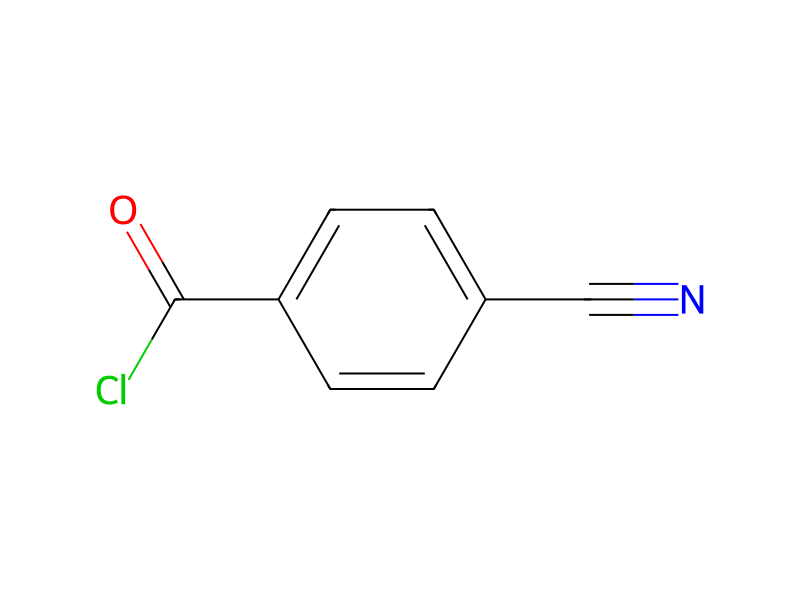

Product 1

Reagents, catalysts & solvents 1

Procedure
A solution of 4-cyanobenzoyl chloride (2.29 g, 13.8 mmol) in dioxane (10 ml) was added to a suspension of 4-(4′-(N-hydroxycarbamimidoyl)biphenyl-4-yloxy)butyric acid (3.23 g, 9.6 mmol) in dioxane (50 ml) and pyridine (2.5 ml, 31.6 mmol). The mixture was stirred at room temperature for 4 h, and then heated to 100° C. for 22 h. The mixture was concentrated to ½ of its original volume, diluted with water (100 ml), and acidified by addition of concentrated hydrochloric acid (3 ml). The product was isolated by filtration and washed with water (50 ml). The solid was suspended in MeCN (70 ml), heated to reflux, allowed to cool, filtered off, and dried under reduced pressure to yield 3.17 g (54%) of 4-(4′-{5-[4-cyanophenyl]-[1,2,4]oxadiazol-3-yl}biphenyl-4-yloxy)butyric acid as a solid.
Workup
- temperatureheated to 100° C. for 22 h
- concentrationThe mixture was concentrated
- additiondiluted with water (100 ml)
- additionacidified by addition of concentrated hydrochloric acid (3 ml)
- customThe product was isolated by filtration
- washwashed with water (50 ml)
- temperatureheated
- temperatureto reflux
- temperatureto cool
- filtrationfiltered off
- customdried under reduced pressure
Sources & evidence
- ORD record
- ord-e960324f953f4ee6bc8a0f6d6eec4927
- Source dataset
- uspto-grants-2015_06
- Patent number
- US09061067B2
Reaction notes
Loading…