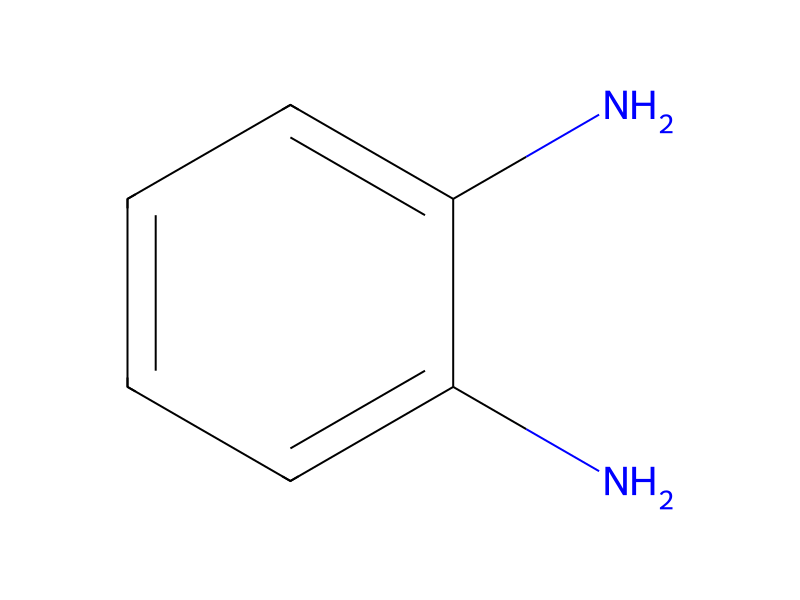
O-Phenylenediamine → 2,3-Bis(4-bromophenyl)quinoxaline
Reaction equation

[Br:1][C:2]1[CH:7]=[CH:6][C:5]([C:8]([C:10]([C:12]2[CH:17]=[CH:16][C:15]([Br:18])=[CH:14][CH:13]=2)=O)=O)=[CH:4][CH:3]=1.[C:19]1([NH2:26])[CH:24]=[CH:23][CH:22]=[CH:21][C:20]=1[NH2:25]>C(Cl)(Cl)Cl>[Br:1][C:2]1[CH:7]=[CH:6][C:5]([C:8]2[C:10]([C:12]3[CH:17]=[CH:16][C:15]([Br:18])=[CH:14][CH:13]=3)=[N:26][C:19]3[C:20](=[CH:21][CH:22]=[CH:23][CH:24]=3)[N:25]=2)=[CH:4][CH:3]=1Participants
Reactant 2

Product 1

Reagents, catalysts & solvents 1

Procedure
Under a stream of nitrogen, 30.2 g (82.0 mmol) of 4,4′-dibromobenzil, 9.31 g (86.1 mmol) of 1,2-phenylenediamine, and 300 mL of chloroform were put into a 500-mL three-neck flask and a reflux thereof was performed at 80° C. for 5 hours. After the reaction, the reaction solution was cooled to room temperature and washed with water. An aqueous layer was extracted with chloroform and dried with magnesium sulfate together with an organic layer. After the drying, the mixture was suctioned and filtrated, and the filtrate was enriched. The obtained solid was dissolved in toluene, and the resulting solution was subjected to suction filtration with florisil, celite, and alumina. The filtrate was enriched, whereby 30.0 g of a white powder solid of 2,3-bis(4-bromophenyl)quinoxaline that was a subject matter was obtained at a yield of 99%.
Workup
- temperaturea reflux
- customAfter the reaction
- washwashed with water
- extractionAn aqueous layer was extracted with chloroform
- dry with materialdried with magnesium sulfate together with an organic layer
- filtrationfiltrated
- dissolutionThe obtained solid was dissolved in toluene
- filtrationthe resulting solution was subjected to suction filtration with florisil, celite, and alumina
- customwas obtained at a yield of 99%
Sources & evidence
- ORD record
- ord-76736fe3b394459491315061c7fe50a4
- Source dataset
- uspto-grants-2015_06
- Patent number
- US09062036B2
Reaction notes
Loading…